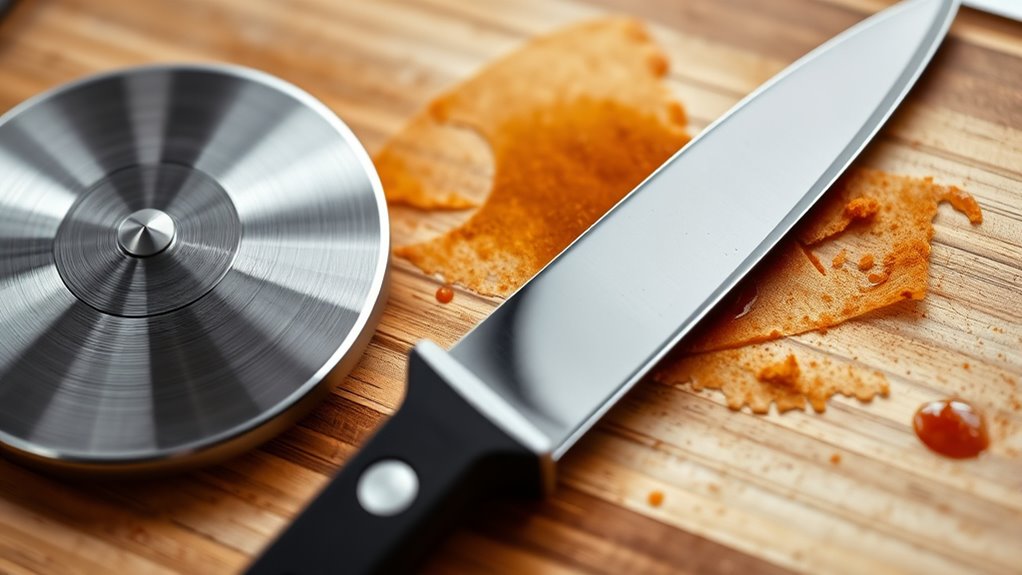

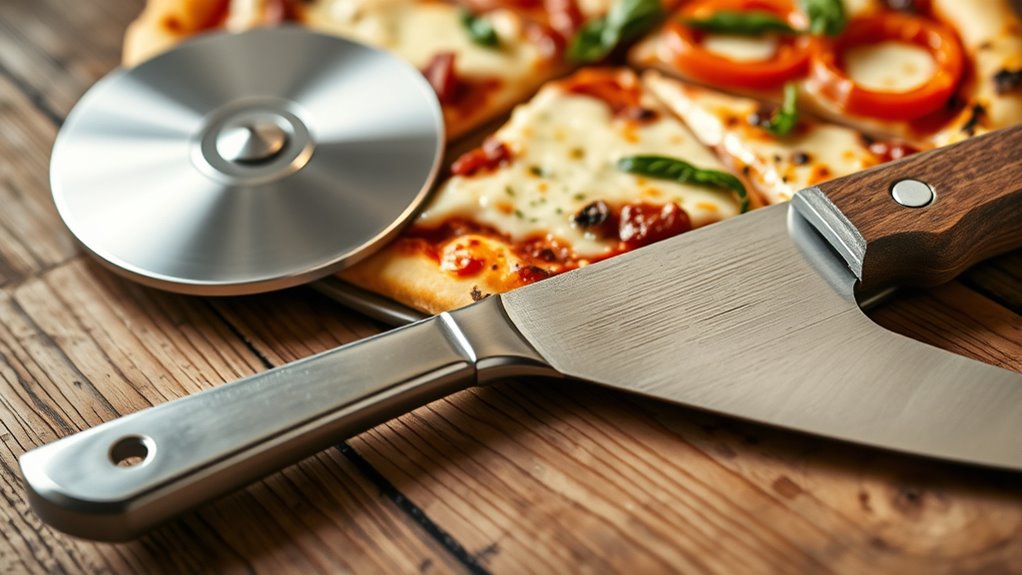
A pizza cutter features a circular blade that rolls through crusts easily, ideal for simple, thin slices. A rocker knife has a curved, chopping motion perfect for thicker or layered crusts and toppings, offering more control and less wrist strain. If you prefer quick, straightforward cuts, the pizza cutter is great. For more precise slices through dense or loaded pizzas, the rocker knife excels. Keep exploring to find out which tool best suits your pizza style.
Key Takeaways
- Pizza cutters use a rotating wheel for quick, easy slicing, ideal for straight and thin crusts.
- Rocker knives feature a curved blade that offers better leverage, especially for thicker or layered pizzas.
- The rocker knife provides more control and reduces wrist strain with a rocking motion, unlike the rolling action of a pizza cutter.
- Pizza cutters can sometimes cause toppings to shift or leave residue, while rocker knives are easier to clean and maintain.
- Choice depends on crust thickness, toppings, and user comfort, with each tool excelling in different slicing scenarios.
When it comes to slicing pizza, choosing the right tool can make all the difference in how smoothly your meal goes from plate to mouth. Two popular options are the traditional pizza cutter and the rocker knife, each offering unique advantages. Understanding their differences involves a bit of dinnerware comparison, as well as an appreciation for kitchen gadget innovations that enhance your cooking experience.
Choosing between a traditional pizza cutter and a rocker knife can transform your slicing experience.
A classic pizza cutter typically features a circular, rotating blade attached to a handle. It’s designed for ease of use, allowing you to roll through thick or thin crusts with minimal effort. Its wheel design ensures clean, uniform slices and is especially effective for cutting straight lines. However, some find it tricky to maneuver around toppings or crust edges, especially if the pizza is uneven or slippery. Still, its compact size makes it easy to store and clean, fitting well into traditional dinnerware sets where space and simplicity matter.
On the other hand, the rocker knife, also known as a mezzaluna or rocking pizza cutter, is a curved blade mounted on a handle that you rock back and forth to cut. This design is a prime example of kitchen gadget innovations aimed at improving control and reducing wrist strain. It provides more leverage and can handle thicker, denser crusts more efficiently. Plus, the rocking motion allows for slicing through multiple layers or ingredients with fewer passes, making it ideal for pizzas loaded with toppings or for cutting herbs and dough. Additionally, the power consumption of these tools is generally low, making them energy-efficient options for frequent use.
When comparing these tools regarding dinnerware compatibility, the rocker knife offers a sleek, minimalist profile that often complements modern dishware and kitchen decor. Its simple, ergonomic design minimizes mess and makes it easier to clean, especially if you’re cutting directly on a pizza stone or cutting board. Conversely, the pizza cutter’s wheel can sometimes leave behind residue or cause toppings to shift, which might not align well with a pristine dining setup.
Innovation in kitchen gadgets continues to influence how we approach everyday tasks like pizza slicing. Advances such as non-stick wheels and ergonomic handles make the traditional pizza cutter more user-friendly, while improved materials and blade shapes boost the rocker knife’s precision and durability. Ultimately, your choice depends on your preferences for control, comfort, and how you view the role of your tools in your overall dinnerware comparison. Whether you favor the classic wheel or the rocking blade, each tool offers distinct benefits that can elevate your pizza experience, making every slice a perfect one.
Frequently Asked Questions
Which Tool Is Safer for Children to Use?
A rocker knife is generally safer for children because it has a blunt, curved blade that minimizes the risk of cuts. When choosing age-appropriate tools for your child, prioritize those with safety features like rounded edges and non-slip handles. Always supervise their use and teach proper handling to ensure child safety. For younger kids, a plastic or safety knife is even better to prevent accidents while they learn to cut food securely.
Can a Rocker Knife Cut Through Thick, Frozen Foods?
A rocker knife isn’t ideal for cutting through thick, frozen foods because its cutting power is limited. The flexible blade and design make it better suited for softer items. For frozen foods, you need a tool with more robust cutting power, like a heavy-duty chef’s knife or an electric knife. Using a rocker knife on frozen items can be ineffective and may damage the blade or cause safety issues.
Are Pizza Cutters Dishwasher Safe?
You might wonder if pizza cutters are dishwasher safe. Many pizza cutters are indeed dishwasher safe, but it’s best to check the manufacturer’s cleaning tips to avoid damage. For easy cleaning, remove the wheel and wash it separately. Hand washing can extend the cutter’s lifespan, especially if it has a wooden handle or delicate parts. Always dry thoroughly to prevent rust and maintain its cutting performance.
How Do Maintenance and Sharpening Differ Between the Two?
You’ll find that maintenance and sharpening differ between a pizza cutter and a rocker knife. With a pizza cutter, the blade durability is generally high, and it often requires only occasional sharpening using a fine file or sharpening stone. In contrast, a rocker knife’s blade may dull faster due to its metal construction, so you should use specific sharpening techniques like honing or grinding to keep it sharp. Regular upkeep ensures both tools perform well.
Which Tool Is More Effective for Cutting Non-Food Materials?
Think of the tool as a key to accessing efficiency. For cutting non-food materials, the rocker knife is your best bet—its sweeping motion offers superior precision cutting and control. It’s designed for industrial use, handling tough, non-food items with ease. The curved blade acts like a sword slicing through obstacles, making it more effective than a pizza cutter, which is better suited for softer, food-related tasks.
Conclusion
So, whether you prefer the swift spin of a pizza cutter or the smooth swing of a rocker knife, remember—your choice depends on your style and the slice you crave. Think of it like a dance partner; each has its own rhythm and flair. Whichever tool you pick, you’ll master the art of perfect pizza slices. After all, isn’t life too short for uneven cuts? Grab your tool and get slicing—your pizza deserves it!