Understanding baker’s percentages helps you easily scale recipes by expressing each ingredient as a percentage of the flour weight. This method simplifies adjustments, whether you’re doubling or halving a batch, ensuring the ratio remains consistent for perfect results. You can quickly see how changing one ingredient impacts the others. By mastering this concept, you gain confidence in recipe development and troubleshooting, and if you keep exploring, you’ll discover even more ways to perfect your baking skills.
Listen free for 30 days with Audible
Thousands of audiobooks and originals — cancel anytime.
As an affiliate, we earn on qualifying purchases.
Key Takeaways
- Baker’s percentages express ingredient weights relative to flour, with total flour set at 100%, simplifying ratio understanding.
- To scale a recipe, adjust the total flour amount, then increase all ingredients proportionally based on their percentages.
- Maintaining the same percentages ensures consistent flavor, texture, and quality across different batch sizes.
- Using baker’s percentages helps identify and fix recipe issues by analyzing ingredient ratios, such as hydration level.
- Mastering these ratios allows for easy recipe modifications and experimentation while preserving balance and consistency.

Have you ever wondered how bakers consistently create perfect recipes? The secret often lies in understanding ingredient ratios and how they relate to recipe scaling. When you grasp these concepts, you gain the ability to adjust recipes effortlessly without sacrificing quality or consistency. Baker’s percentages are a straightforward system that makes this possible, especially when you’re working with different batch sizes or experimenting with new ingredients. Instead of relying solely on traditional measurements like cups or grams, baker’s percentages express each ingredient as a proportion of the total flour weight. This approach simplifies scaling recipes up or down because the ratios stay constant, ensuring the flavor and texture remain consistent regardless of the batch size.
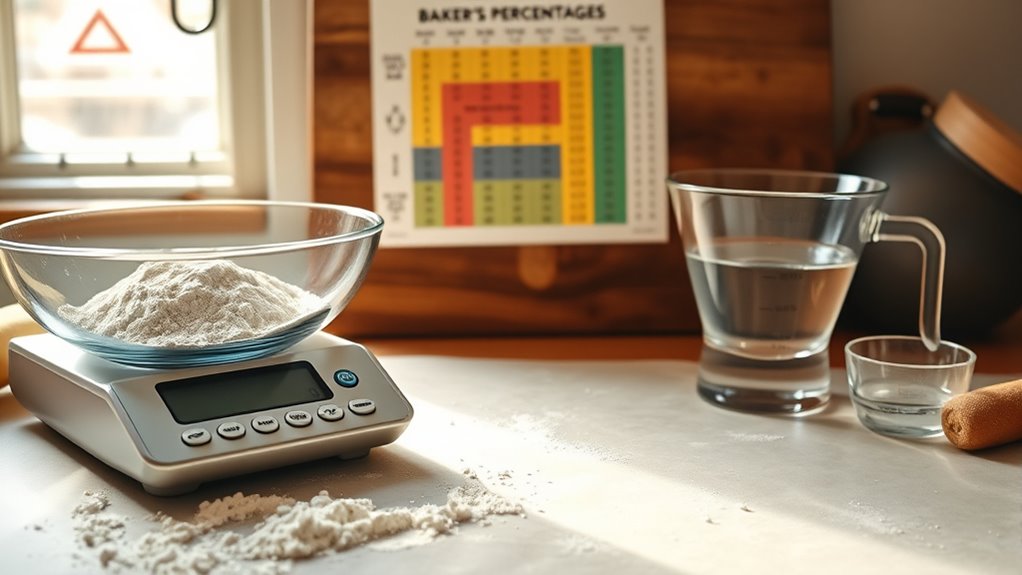
To start, you assign the total weight of flour a value of 100%. All other ingredients are then expressed as a percentage of that flour weight. For example, if your recipe calls for 500 grams of flour, and you add 300 grams of water, the water’s percentage is 60% because 300 is 60% of 500 grams. This method makes it easy to see at a glance how much of each ingredient you need, and it simplifies adjusting those amounts. When you want to scale a recipe, you simply decide on a new total flour weight and adjust the other ingredients proportionally. If you want a larger loaf, you might double the flour to 1000 grams, then double all other ingredients accordingly. Conversely, for a smaller batch, cut the flour in half and reduce other ingredients proportionally. This process, known as recipe scaling, is much more straightforward with baker’s percentages because you’re working with ratios, not fixed measurements.
Using ingredient ratios and recipe scaling also helps you troubleshoot recipes. If your bread turns out too dense, you can look at the percentage of water or yeast and make adjustments for next time. Since the ratios are clear and consistent, you can modify just the problematic ingredient without reworking the entire recipe. This flexibility is especially useful when developing new recipes or adapting traditional ones to different environments, like high altitudes or humid climates. Additionally, understanding baker’s percentages allows you to experiment confidently, knowing that your adjustments will maintain the desired balance. By mastering baker’s percentages, you’ll gain a precise control over your baking process, allowing you to reproduce results every time and confidently experiment with new ideas. Whether you’re baking for a small family or a bakery, understanding these fundamental concepts will elevate your skills and make recipe scaling an intuitive, reliable process.
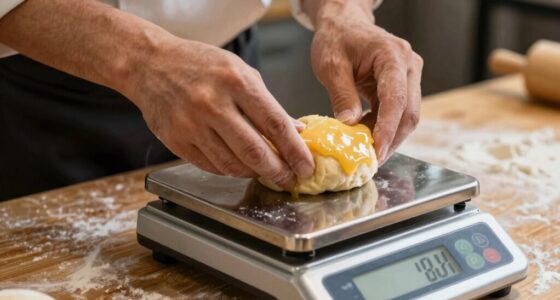
baking scale for baker's percentages
As an affiliate, we earn on qualifying purchases.
As an affiliate, we earn on qualifying purchases.
Frequently Asked Questions
How Do Baker’s Percentages Apply to Non-Baked Recipes?
You can apply baker’s percentages to non-baked recipes by using ingredient ratio adjustments to maintain consistency. Think of it as a way to scale recipes accurately using recipe scaling techniques, ensuring the proportions stay balanced regardless of the quantity. Convert each ingredient to a percentage of the total, then adjust those percentages to fit the desired yield. This method helps you achieve reliable results, whether you’re making a salad dressing or a marinade.
Can Baker’s Percentages Be Used for Gluten-Free Baking?
Yes, you can use baker’s percentages for gluten-free baking. You just need to adapt the method for gluten-free alternatives, ingredient substitutions, and different flour types. Focus on balancing moisture, structure, and binding agents like xanthan gum or eggs. By adjusting percentages based on the specific ingredients, you’ll gain better control over your recipes, ensuring consistent results even without traditional wheat flour.
What Tools Are Best for Calculating Baker’s Percentages?
You’ll find digital calculators and spreadsheet templates are your best tools for calculating baker’s percentages. Digital calculators simplify the process, allowing you to input ingredient weights and instantly see percentages. Spreadsheet templates, like Excel or Google Sheets, help you organize and scale recipes efficiently, especially for multiple batches. Both tools save time, reduce errors, and make scaling recipes more accurate, ensuring consistent results every time you bake.
How Do Ingredient Variations Affect Baker’s Percentage Calculations?
Ingredient variations, like substitutions or measurement inaccuracies, impact baker’s percentage calculations because they change the weight ratios of ingredients. When you swap ingredients or don’t measure precisely, the percentages shift, affecting dough consistency and final product quality. To keep your calculations accurate, always use precise measurements and note any ingredient substitutions. This helps make sure your scaled recipes maintain the intended texture, flavor, and structure.
Are Baker’s Percentages Suitable for Professional Bakery Scaling?
Coincidentally, baker’s percentages work well for professional bakery scaling because they allow you to handle ingredient substitutions and moisture adjustments seamlessly. These percentages give you a clear, consistent way to scale recipes accurately, ensuring quality and consistency across batches. Whether you’re adjusting for ingredient variations or moisture content, baker’s percentages help you maintain precise ratios, making them highly suitable for professional settings that demand precision and efficiency.
As an affiliate, we earn on qualifying purchases.
Conclusion
Mastering baker’s percentages is like having a map for your recipes—everything falls into place when you understand the ratios. Once you get the hang of it, scaling recipes becomes as easy as turning a dial. Think of these percentages as your baking GPS, guiding you to perfect results every time. With this knowledge, you’ll bake with confidence, knowing you can adjust any recipe like a pro, just as a captain navigates through familiar waters.
As an affiliate, we earn on qualifying purchases.
professional baker's percentage chart
As an affiliate, we earn on qualifying purchases.
As an affiliate, we earn on qualifying purchases.
Fall Picks
fall essentials
As an affiliate, we earn on qualifying purchases.