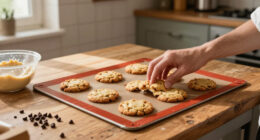
To make certain your oven heats accurately, place your oven thermometer in the center and preheat to a specific temperature. Once heated, check the thermometer and compare it with your oven’s display. If there’s a discrepancy, you can adjust the oven’s calibration setting if available, or note the difference to tweak your cooking times. Regular checks help maintain accuracy, and if you keep exploring, you’ll discover detailed calibration tips to improve your baking results.

Get baking supplies delivered free with Prime
- Fast, free delivery on millions of items
- Prime Video, Amazon Music and more included
- Member-only deals all year
Key Takeaways
- Place the oven thermometer in the center of a preheated oven and compare its reading to the oven’s displayed temperature.
- Use the oven’s calibration setting or manual adjustments to align the oven’s temperature with the thermometer’s reading.
- Re-test the oven after calibration to ensure the temperature is accurate within 5°F, making further adjustments if needed.
- Regularly re-test and calibrate the oven to maintain accurate cooking temperatures and prevent under or overcooking.
- For precise calibration, consider professional help to adjust the thermostat or control board if simple methods are insufficient.

Ensuring your oven reaches the correct temperature is essential for baking and cooking success, and using an oven thermometer makes this task simple and accurate. Many built-in oven thermostats can be off by several degrees, which can lead to over or undercooked dishes. That’s why checking the oven temperature with a reliable oven thermometer is crucial. When you’re focused on precision, calibration techniques come into play. They help you fine-tune your oven’s accuracy, ensuring it heats as advertised.
To start, you need to test your oven’s temperature with an oven thermometer placed in the center of the oven. Preheat your oven to a specific temperature, like 350°F, and let it run for about 15-20 minutes. Then, open the oven door and check the thermometer reading immediately. If the displayed temperature and the thermometer differ, it’s time to calibrate. Calibration techniques vary depending on the oven model, but many ovens have a calibration setting—often found in the control panel or user manual—that allows you to adjust the temperature reading. If your oven lacks this feature, you can manually note the discrepancy and compensate by adjusting your cooking time or temperature accordingly.
Test oven with thermometer at 350°F, then calibrate or adjust accordingly.
In some cases, you might need to perform a more detailed calibration process. This involves adjusting the thermostat or control board directly, which may require professional help if you’re not comfortable with electrical components. For most home cooks, a simple calibration using the oven’s built-in settings or an external adjustment method works well. Once calibrated, you should re-test the oven temperature to verify the accuracy. Repeat the process until the thermometer and oven display match closely, ideally within 5°F.
Proper calibration techniques ensure that you’re baking at the correct oven temperature, which is vital for consistent results. Remember, even new ovens can be inaccurate, so it’s good practice to perform this check periodically. Also, keep in mind that oven temperature can fluctuate during operation, so using an oven thermometer during cooking can provide real-time insight. Regular calibration not only saves you from overcooked or undercooked meals but also extends the lifespan of your appliance by reducing undue stress on heating elements. Additionally, storing your oven in a cool, dark place can help maintain its accuracy over time. Ultimately, investing a little time into calibration techniques guarantees that your oven operates at peak accuracy, making every baking session more predictable and successful.
As an affiliate, we earn on qualifying purchases.
Frequently Asked Questions
How Often Should I Calibrate My Oven Thermometer?
You should calibrate your oven thermometer at least once a year to guarantee accuracy, considering its lifespan and how often you use it. If you notice inconsistent temperatures or your baked goods aren’t turning out right, calibrate more frequently. Regular calibration helps maintain precise readings, extending your thermometer’s lifespan and ensuring your oven’s temperature is always correct. This simple step keeps your cooking consistent and reliable over time.
Can Oven Thermometers Be Used for Grilling?
Did you know that 86% of outdoor cooks rely on accurate grill temperature? Yes, you can use oven thermometers for grilling, but keep in mind they’re not designed for outdoor conditions. An oven thermometer can help you monitor indoor grill temperatures, ensuring your food cooks evenly. Just make sure it’s heat-resistant and positioned correctly. For precise outdoor cooking results, investing in a grill-specific thermometer is often the best choice.
What Types of Oven Thermometers Are Most Accurate?
You’ll find that digital oven thermometers are most accurate because they provide precise temperature readings and consistent temperature measurements. To guarantee temperature consistency, place the thermometer correctly—usually in the center of the oven, away from walls or racks. This proper placement helps you get reliable readings, so you can confidently monitor your oven’s temperature and achieve perfectly cooked dishes every time.
How Do I Troubleshoot Inconsistent Temperature Readings?
If you’re experiencing inconsistent temperature readings, start by checking your oven calibration and compare it with your thermometer. Keep an eye on temperature fluctuation during preheating and cooking. If you notice significant differences, recalibrate your oven or replace the thermometer if it’s faulty. Regularly calibrating guarantees accurate readings, helping you avoid uneven cooking and improve your baking consistency.
Are Digital Thermometers More Reliable Than Analog Ones?
Digital thermometers are generally more reliable than analog ones because they offer better digital accuracy and are less affected by external factors. Analog thermometers often have limitations like slow response times and potential mechanical issues. You’ll find digital models easier to read and more precise, especially when calibrating or troubleshooting inconsistent readings. Overall, opting for a digital thermometer helps guarantee your oven temperature stays consistent and accurate.
As an affiliate, we earn on qualifying purchases.
Conclusion
So, steady your senses and sort out your stove’s sincerity. With a simple, savvy check, you’ll stay sure your oven’s settings are spot-on, saving time and tantalizing taste buds. Remember, a well-worn thermometer tells a truthful tale, turning every baking and broiling into a perfect performance. Stay vigilant, calibrate confidently, and enjoy consistently crisp, crave-worthy creations. Your oven’s accuracy is the key—keep it calibrated, and your culinary creations will always come out craving applause.
As an affiliate, we earn on qualifying purchases.
As an affiliate, we earn on qualifying purchases.
Halloween Picks
halloween
As an affiliate, we earn on qualifying purchases.