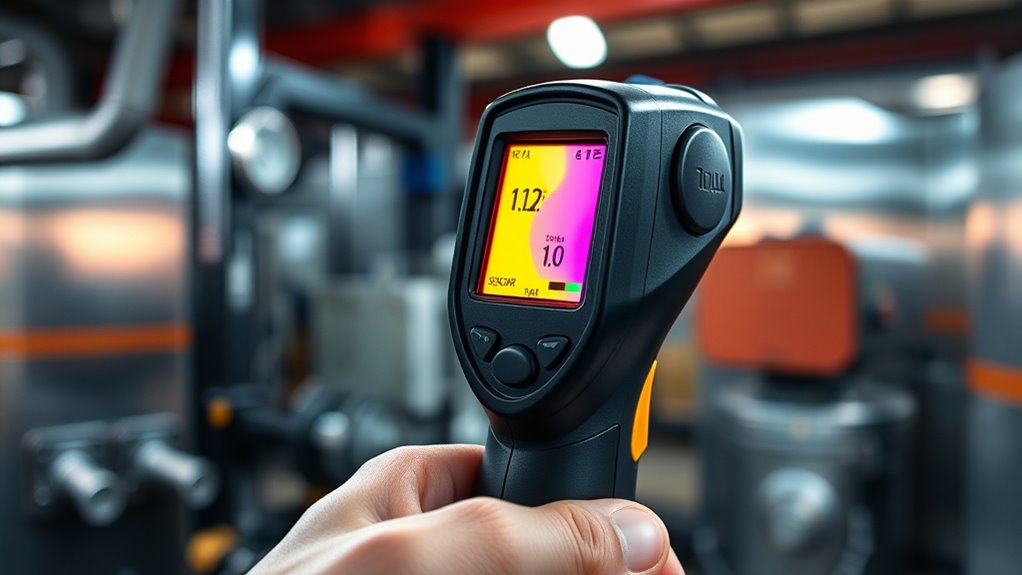

Infrared thermometers let you quickly measure surface temperatures without contact by pointing at the target and pressing a button. Make sure you’re aimed at the right spot, usually the center, and maintain the proper distance for accurate results. Keep in mind, they only measure surface temperature, so factors like emissivity, reflectivity, and dirt can affect accuracy. To learn more about getting the best results and limitations, keep exploring what these devices can do for you.
Key Takeaways
- Aim at the target surface, maintaining proper distance as specified by the device’s distance-to-spot ratio.
- Adjust emissivity settings when possible for more accurate temperature readings.
- Use on non-reflective, matte surfaces for better accuracy; avoid shiny or reflective surfaces.
- Infrared thermometers measure only surface temperature, not internal or core body temperature.
- External factors like sweat, dirt, or ambient temperature can affect measurement accuracy.
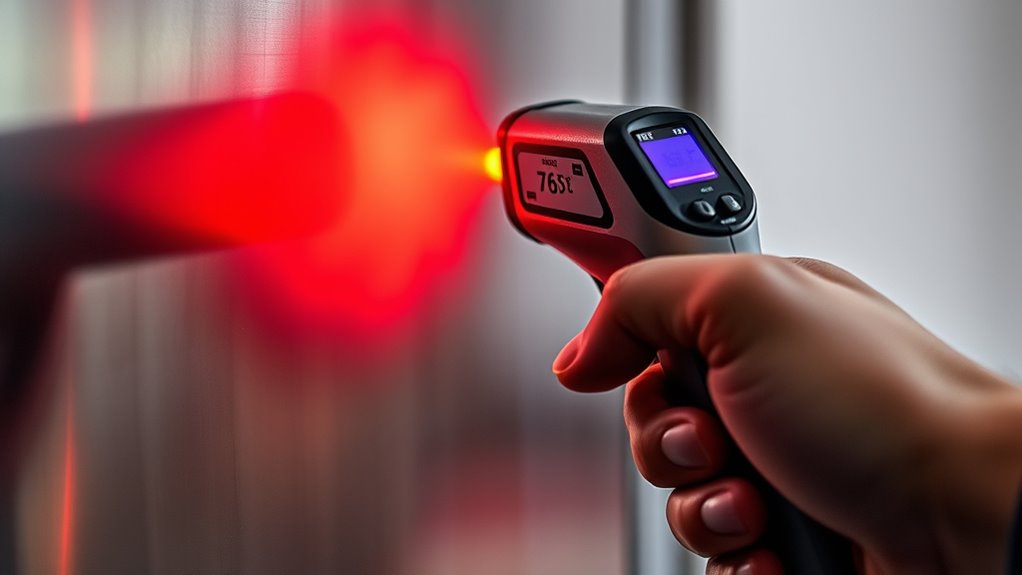
Have you ever wondered how infrared thermometers can quickly and accurately measure temperature without direct contact? These devices use non contact measurement to assess surface temperature efficiently, making them popular in various settings. Instead of touching a person or object, you simply point the thermometer at the target and press a button. The device then detects infrared radiation emitted by the surface, converting it into a temperature reading almost instantly. This method is especially useful in situations where hygiene is critical or where physical contact could be problematic, such as in medical environments or food processing plants. Because there’s no need for contact, you can quickly check multiple people or surfaces without cross-contamination concerns, saving time and reducing the risk of spreading germs.
Infrared thermometers quickly measure surface temperature without contact, ideal for hygienic and efficient temperature checks.
The key to accurate readings with infrared thermometers lies in understanding how they measure surface temperature. The device’s sensor captures the infrared energy radiated from the surface, which varies depending on the material’s temperature and emissivity. Emissivity refers to how well a surface emits infrared radiation; different materials have different emissivity levels, which can affect the accuracy of your measurements. Some infrared thermometers allow you to adjust for emissivity, ensuring you get a more precise reading. When using the device, it’s important to aim at the correct spot on the surface, typically the center, and maintain the recommended distance specified by the manufacturer. Too close or too far can lead to inaccurate results, so paying attention to the device’s distance-to-spot ratio helps you maintain measurement precision. Additionally, using infrared thermometers on recycled materials or surfaces with varied emissivity can sometimes lead to less accurate readings if not properly calibrated.
However, infrared thermometers aren’t foolproof. They can’t measure internal body temperature or the temperature of objects beneath surfaces. For example, trying to gauge someone’s core temperature with an infrared device on their forehead only provides an approximation based on skin surface temperature, which can be influenced by external factors like sweat, dirt, or ambient temperature. Similarly, when measuring the temperature of reflective or shiny surfaces, readings can be skewed because these surfaces emit less infrared radiation. In such cases, applying a matte coating or using different measurement techniques might be necessary.
While infrared thermometers excel at providing quick, contactless surface temperature readings, they do have limitations. They’re best suited for surface measurements and aren’t designed for internal or subsurface temperature assessments. To get the most accurate results, you should understand the principles behind their operation, pay attention to the emissivity of surfaces, and follow the manufacturer’s guidelines for distance and targeting. With proper use, infrared thermometers can be invaluable tools for fast, hygienic temperature checks in many situations.
Frequently Asked Questions
How Accurate Are Infrared Thermometers Compared to Traditional Thermometers?
Infrared thermometers are generally accurate, but their measurement limitations can affect reliability. Environmental influences like ambient temperature, humidity, or nearby heat sources can skew readings, so you need to take these factors into account. While they provide quick results, they might not match the accuracy of traditional thermometers for precise medical measurements. Always follow proper usage guidelines to minimize errors and ensure more accurate readings.
Can Infrared Thermometers Measure Temperature Through Clothing?
Think of infrared thermometers as detectives peering through fog—they can’t see beyond clothing interference. You can’t rely on them to measure surface temperature through clothing because fabric acts like a barrier, blocking accurate readings. The thermometer detects emitted infrared radiation from the skin, but clothing masks this signal. So, for precise results, guarantee the skin is exposed, or else your measurement might be as misleading as a mirage.
Are Infrared Thermometers Effective for Measuring Surface Temperatures of Liquids?
Infrared thermometers are not effective for measuring liquid surface temperatures because liquids emit infrared radiation differently than solids, and surface reflections can skew results. You should avoid relying on them for liquids, as measurement limitations exist due to the liquid’s reflective and uneven surface. Instead, use a probe thermometer designed for liquids to get accurate readings, since infrared devices are better suited for solid surface temperature measurements.
How Often Should I Calibrate My Infrared Thermometer?
Think of calibration as tuning a musical instrument—you need to do it regularly for perfect harmony. You should calibrate your infrared thermometer weekly or anytime you notice inconsistent readings. This guarantees temperature consistency and accuracy. If you’re using it daily or in critical environments, more frequent calibration might be necessary. Regular calibration keeps your measurements reliable, preventing costly errors and helping you maintain precise, trustworthy results every time you check temperatures.
Can Infrared Thermometers Detect Internal Body Temperature Accurately?
Infrared thermometers aren’t designed to accurately detect your core body temperature. They measure surface temperature, which can vary due to factors like skin condition or ambient temperature, leading to temperature variance. While they provide quick readings, they may not reflect true internal body temperature. For precise measurement of your core body temperature, methods like oral, rectal, or ear thermometers are more reliable.
Conclusion
Infrared thermometers are handy tools, but they’re not perfect. They give you quick readings, like a flash of lightning, but can’t replace traditional methods in every situation. Remember, their accuracy depends on proper use and conditions. So, don’t rely solely on them—think of them as a helpful guide, not the final word. By understanding their limits, you’ll be better equipped to make informed health decisions, turning a simple tool into your trusted ally.