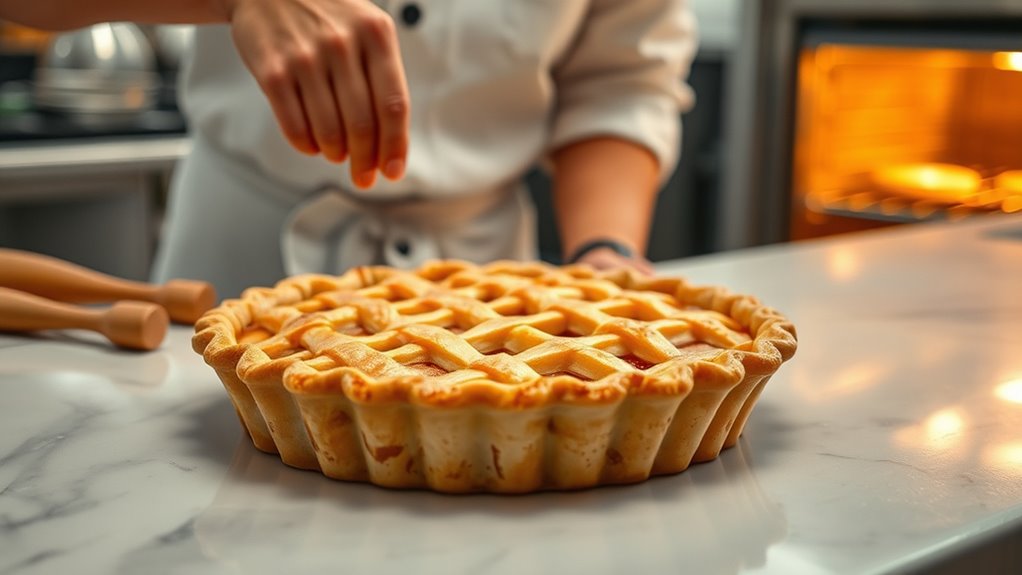

To turn your pies without burning, gently rotate them only once or twice during baking—preferably when the crust is golden and the filling is bubbling. Avoid overturning, which can disrupt the crust and cause uneven baking or sogginess. Keep the oven temperature steady and use visual cues rather than timers alone. With the right technique and timing, you’ll get perfectly baked pies every time—keep going, and you’ll discover even more pro tips.
Open a free Amazon Business account
Business pricing, bulk buying and tax-exempt orders.
As an affiliate, we earn on qualifying purchases.
Key Takeaways
- Turn the pie gently and sparingly, ideally once or twice, to prevent crust disruption and uneven baking.
- Use visual cues like a golden crust and bubbling filling to determine when to turn, not just time.
- Wait until the crust is partially baked and stable before turning to avoid breaking or sogginess.
- Turn the pie at moderate oven temperatures (375°F–400°F) to minimize risks of burning or uneven heat.
- Keep oven temperature steady; avoid turning during high-heat phases to prevent crust scorching.

Koolstuffs Silicone Baking Mat, Nonstick and Reusable, 3 Pack
- Easy Cleanup: Dishwasher safe and residue-free
- Nonstick Surface: Foods release easily, no oil needed
- Flexible Sizes: Includes two large and one small mat
As an affiliate, we earn on qualifying purchases.
Mastering Pie Turning for Even Baking

Baking a perfect pie often requires turning it during cooking to guarantee even heat distribution, but if you’re not careful, you might end up with a burnt crust or uneven filling. The secret lies in understanding how oven temperature and baking time influence the process. When you turn a pie too early or too often, you risk disrupting the crust’s structure, causing it to become soggy or burnt before the filling is fully cooked. Conversely, if you wait too long to turn it, hot spots can create uneven browning, leaving parts of your crust overly dark while others remain pale.
Oven temperature plays a pivotal role in how your pie bakes. A higher temperature might seem tempting for a quick bake, but it increases the risk of burning the crust if you’re not attentive. Many pros recommend baking pies at a moderate temperature—around 375°F to 400°F—so that heat penetrates evenly, and turning the pie doesn’t cause drastic temperature fluctuations. Maintaining a steady oven temperature ensures the crust and filling cook uniformly, reducing the need for turning altogether. Still, if your oven has hot spots or your pie is particularly large, turning it becomes necessary to achieve an even bake. Additionally, understanding baking techniques can help you optimize your process for better results.
Baking time is equally essential. Overbaking can lead to a burnt crust, especially if you turn the pie multiple times, exposing different sections to direct heat. Underbaking, on the other hand, leaves the filling runny and the crust pale. To balance this, set a timer based on your pie’s size and type—most fruit pies take about 45-50 minutes. When turning, do so gently and sparingly—ideally once or twice—to help the heat distribute evenly without disrupting the crust’s integrity. Use visual cues, like a golden-brown crust and bubbling filling, to determine if the pie is ready, rather than relying solely on the clock.
Set a timer and turn gently to ensure even baking without overdoing it.
In essence, mastering the art of turning pies without burning involves controlling oven temperature and monitoring baking time carefully. When these elements are optimized, turning becomes a tool to fine-tune the bake rather than a gamble. Remember, patience and attentiveness are your best allies. Keep your oven at a consistent temperature, check on your pie periodically, and turn it only when necessary—this way, you’ll end up with a beautifully baked pie, evenly cooked and free of burnt spots.

Amazon Basics Silicone Rectangular Baking Mat, Non-Stick, Reusable, Dishwasher Safe, Food Safe, Heat Resistant, 16.5" x 11.6", Beige/Gray, 2-Pack
- Package Includes: 2 silicone baking mats
- Reusable Design: Food-safe and eco-friendly
- Non-Stick Surface: No oil or sprays needed
As an affiliate, we earn on qualifying purchases.
Frequently Asked Questions
Can I Turn My Pie Without Using a Special Turning Tool?
Yes, you can turn your pie without a special turning tool. Use a wide spatula or a couple of large spoons to gently lift and rotate the pie. For decorative pie edges, take extra care to avoid damaging the crust. While pie turning utensils make it easier, patience and gentle handling are key. Practice helps you master turning your pie smoothly, ensuring it looks beautiful and baked evenly without burning.
How Do I Prevent Filling From Spilling When Turning?
You might think the secret is in a fancy tool, but it’s actually about pie crust stability. To prevent filling leakage when turning, let your pie cool slightly so the filling thickens. Use a wide spatula or your hands to support the bottom and sides, and turn gently. This way, your filling stays put, and your crust remains intact—no spills, no burns, just perfect pie every time.
Is It Necessary to Turn Pies During the Entire Baking Process?
You don’t need to turn pies during baking. Instead, focus on maintaining even heat in your oven to guarantee consistent pie crust textures and filling consistency. Turning can cause uneven cooking or spills, especially if the filling is delicate. If you notice uneven browning, rotate the pie only once midway through baking. This helps you achieve a perfectly baked crust and filling without risking spills or burnt spots.
What Are the Signs of Over- or Under-Baked Pie When Turning?
You notice an over-baked pie when the crust turns dark amber or almost burnt, and the filling becomes stiff or cracked. Under-baking shows in a pale crust and a runny, watery filling that jiggles excessively. When turning, watch for these signs: if the crust looks unevenly colored or the filling’s too loose, it’s a cue to adjust your timing. Your pie’s perfect turn reveals a beautifully golden crust and a luscious, firm filling.
How Does Oven Type Affect Pie Turning Techniques?
Your oven type greatly impacts pie turning techniques. If your oven isn’t properly calibrated, it can cause uneven heat, making it tricky to turn pies without burning. Use the oven rack positioning to your advantage—place pies on a lower rack for even browning, or higher if the bottom heats too quickly. Adjust your approach based on whether you have a convection or conventional oven to prevent over- or under-baking.
Conclusion
Mastering pie turning is like fine-tuning a musical instrument—you need patience and a gentle touch. When you flip your pies carefully, you ensure even baking and a perfect crust every time. Remember, rushing the process is like trying to catch smoke—you’ll end up with burnt spots or uneven results. With practice, you’ll turn pies with confidence, achieving bakery-quality perfection. Just stay steady and patient; your delicious masterpiece is worth it.
NFL season / tailgating Picks
team gear
As an affiliate, we earn on qualifying purchases.