
TL;DR

Get baking supplies delivered free with Prime
- Fast, free delivery on millions of items
- Prime Video, Amazon Music and more included
- Member-only deals all year
Building your own AI workstation used to be cheaper, but recent market shifts mean prebuilt systems often match or beat DIY on cost and reliability. Your choice depends on support needs, customization, and how quickly you want to deploy.
Imagine firing up a new AI project. You’re eager, but the question hits like a punch: do you build your own workstation, or buy one ready-made?
For years, the answer was simple—build was cheaper, buy was faster. But in 2026, that rule no longer holds. The AI boom and supply chain chaos have shifted the landscape. Now, the real decision isn’t just about price, but about speed, support, and how much control you want.
This guide cuts through the noise, comparing building versus buying with a focus on heat, noise, and long-term value. Want your AI rig to run cool, quiet, and reliable? Keep reading.
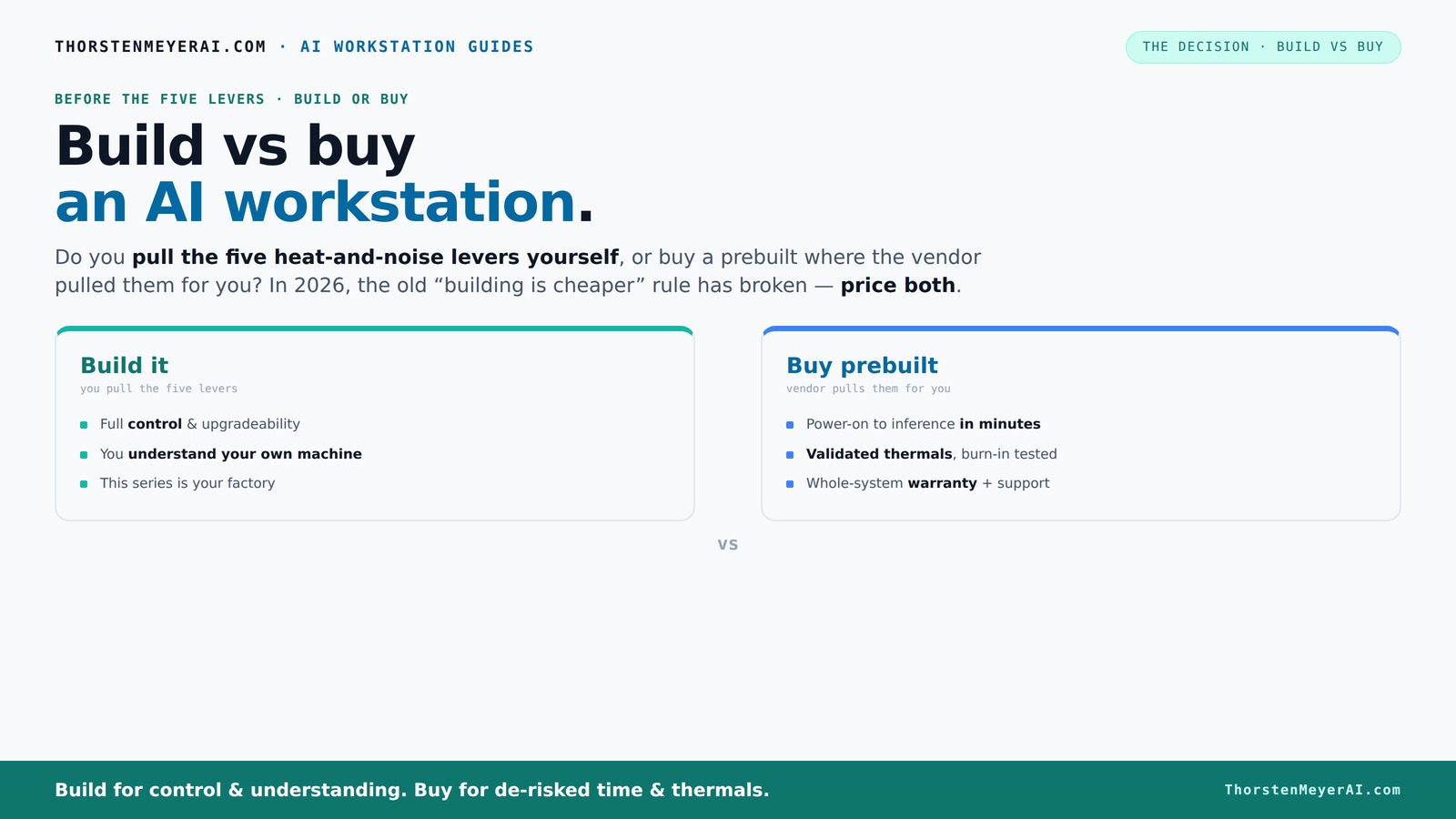
Build vs buy
an AI workstation.
The real question behind this whole series: do you pull the five heat-and-noise levers yourself, or buy a prebuilt where the vendor pulled them for you? And in 2026, the old “building is cheaper” rule has broken. Match your situation in Part 3.
Key Takeaways
- Component shortages have made prebuilt AI workstations often more cost-effective than DIY in 2026.
- Vendors actively tune thermal and acoustic performance, saving you time and effort if you buy.
- DIY offers unmatched customization but requires deep knowledge, time, and troubleshooting skills.
- Support, warranty, and reliability are often stronger with prebuilt systems, especially for multi-GPU setups.
- Evaluate total cost of ownership—initial price, time, support, and upgrades—before deciding.
As an affiliate, we earn on qualifying purchases.
Why the old rule of thumb no longer applies in 2026
Building your own AI workstation isn’t automatically cheaper anymore. Build vs Buy a Prebuilt AI Workstation. Component shortages have driven up prices for GPUs, RAM, and SSDs. Where you once could assemble a system for $1,000, now it’s often $1,250 or more—before even adding software or support costs.
Meanwhile, big vendors bought components early, locking in prices and volume discounts. They now offer systems that are surprisingly close to or even below DIY prices. The age-old idea that building saves money? It’s outdated in today’s volatile market.
According to recent market data, the cost gap has closed or reversed, making prebuilt options a serious contender on price, especially when factoring in time and effort.
As an affiliate, we earn on qualifying purchases.
The five levers: heat, noise, and how a vendor pulls them for you
High-performance AI workstations are like furnaces. To keep them cool and quiet, you need to master five levers: undervolt the GPU, match the cooling system, optimize case airflow, tune fans, and position the system well.
Buy a prebuilt → the vendor handles these levers. They validate thermals, run burn-in tests, and tune fan curves—sometimes even with water cooling—so your machine runs whisper-quiet and cool under load.
Build it yourself → you pull these levers. It’s rewarding, but requires expertise and time. You’ll pick parts, tweak settings, and troubleshoot thermal issues yourself. The tradeoff: total control versus effort.
For example, a vendor like Lambda claims their systems run up to 30% cooler and quieter because of factory tuning—something that’s tough to replicate at home without deep knowledge.
As an affiliate, we earn on qualifying purchases.
When buying is your best move (and how to spot it)
If you value plug-and-play simplicity, support, and guaranteed thermals, buying makes sense. A prebuilt system arrives with the OS, drivers, and software stacks ready—saving you hours of setup time.
For instance, if you’re a researcher needing to start training models today, a prebuilt from a vendor like Puget or BIZON can have you up and running in under an hour. They test the system under load, ensuring no thermal throttling or noise surprises.
Plus, support matters. When your system crashes during a long training run, a vendor-backed warranty means quick fixes, not endless troubleshooting. This level of confidence is hard to match with a DIY build.
Recent trends also show that for multi-GPU setups, vendors optimize power delivery and cooling, reducing your headaches and downtime.
As an affiliate, we earn on qualifying purchases.
When building your own makes sense (and how to do it right)
If you’re a hobbyist, student, or someone who loves the process, building your own AI workstation offers unmatched customization. Want a super-quiet rig with specific cooling or a unique GPU setup? DIY is your playground.
Start with choosing a quiet GPU and an undervolt-friendly power supply. Pick a quiet cooler and a low-noise case. Tune the fans, optimize airflow, and you get a system tailored exactly to your needs.
It’s more work but offers flexibility—plus, the satisfaction of knowing you built it. The key is to research each component, test thermals, and be prepared for troubleshooting. Resources like heat and noise reduction techniques can guide you.
Performance per dollar: what really matters in 2026
Buyers focus on the value of their investment. In 2026, the question isn’t just “which is cheaper?” but “which offers the best performance for my budget?”
For example, a high-end prebuilt with a 4090 GPU, 128GB RAM, and fast SSD can cost around $3,500. Building a similar setup might be comparable in price but requires significant time and expertise—especially to optimize thermal performance.
Some vendors claim local workstations can be more cost-effective than cloud for sustained workloads, but that depends on electricity costs, depreciation, and usage patterns. The key is to compare total cost of ownership, not just initial price.
Trends shaping the AI workstation market in 2026
The market now emphasizes AI-ready systems with plug-and-play software stacks and hardware optimized for AI workloads. Vendors highlight NPUs and other accelerators, making systems faster and easier to deploy.
Prebuilts are improving in value thanks to OEM deals, assembly efficiencies, and bundled support. Cloud isn’t the default anymore; many high-utilization workloads are better served locally.
Support for AI-specific features, like validated thermal management and software compatibility, makes prebuilt systems more appealing. The choice now hinges on your workflow, budget, and need for control.
Who should choose each option: real-world scenarios
**Solo creator or hobbyist:** Building is often best if you love tuning, troubleshooting, and customizing. It’s cheaper and educational.
**Researcher or startup:** Buying saves time and reduces risk. You can get a validated, thermally optimized system that’s ready to run.
**Enterprise or heavy user:** A prebuilt with enterprise support and warranty minimizes downtime and offers peace of mind.
Think about your workload, expertise, and how fast you need results. Match your scenario to the right approach.
Frequently Asked Questions
Is it cheaper to build or buy a prebuilt AI workstation?
It depends. Recent market shifts have closed the cost gap. Prebuilts often match or beat DIY prices when you factor in time, support, and thermal tuning. Always compare specific configurations before deciding.
How much do I really save by building it myself?
While building can save money upfront, it requires significant time, expertise, and troubleshooting effort. The real savings often come from customization and learning, not just dollars.
What’s the best option for training versus inference?
If you need quick deployment and reliability, a prebuilt is ideal. For customized setups, especially if you’re experimenting or tuning, DIY offers more flexibility.
How many GPUs do I need for my workload?
It varies. Light training might need 1-2 GPUs, while large models can demand 4 or more. Check your framework’s recommendations and thermal capacity before scaling up.
Are prebuilt workstations good enough for serious AI work?
Yes. Reputable vendors validate thermals, support multi-GPU setups, and provide warranties. They’re a solid choice if you prioritize reliability and support over total customization.
Conclusion
In the end, the best choice depends on what you value most: control and customization or convenience and support.
In 2026, the market blurs the lines—prebuilts often match or beat DIY on price and reliability. Your decision should reflect your workflow, expertise, and how quickly you need your AI to run.
Remember, a well-chosen system is like a good engine: it propels your projects forward without breaking down. Which path will you take?
Fall Picks
fall essentials
As an affiliate, we earn on qualifying purchases.