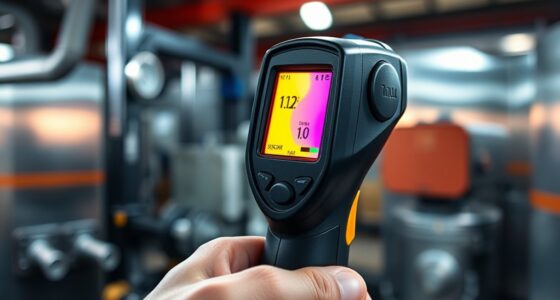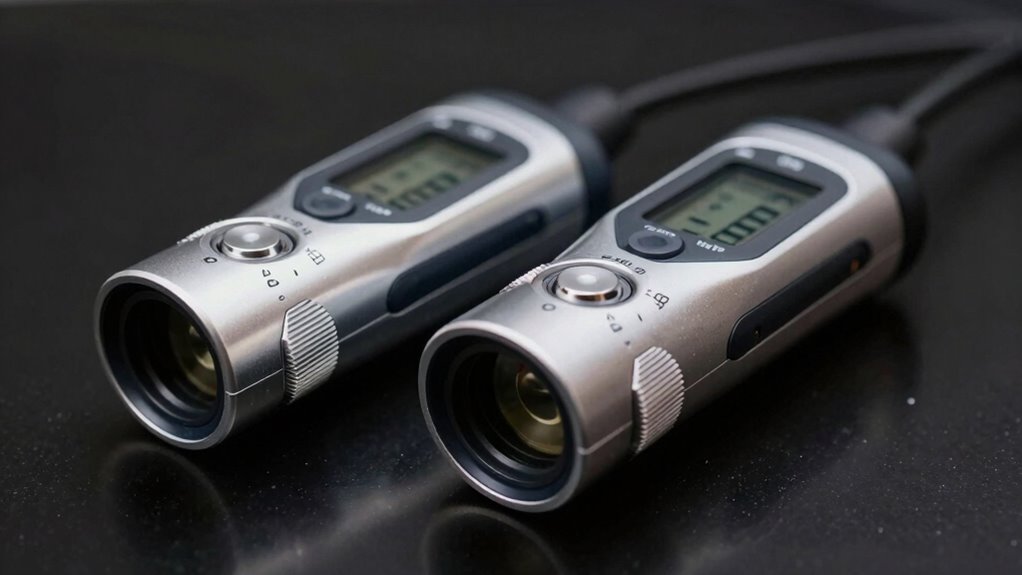

Thermometers with adjustable emissivity might sound technical, but they greatly improve accuracy by accounting for different surface materials. When you measure surfaces like shiny metal or matte plastic, their emissivity affects readings. Adjusting it guarantees you get precise and consistent results every time. This reduces errors and boosts your confidence in the data, especially for critical tasks. Keep exploring to uncover how this feature helps you achieve professional-level temperature measurements with ease.
Key Takeaways
- Adjustable emissivity ensures accurate readings across different surface materials, preventing measurement errors.
- Proper calibration maintains device reliability and consistency over time, crucial for professional or scientific use.
- Versatile emissivity controls simplify measurement in diverse environments, reducing the need for multiple devices.
- Accurate infrared temperature readings improve safety, quality control, and decision-making in various applications.
- Buyers value these features as they enhance measurement precision, saving time and increasing confidence in results.
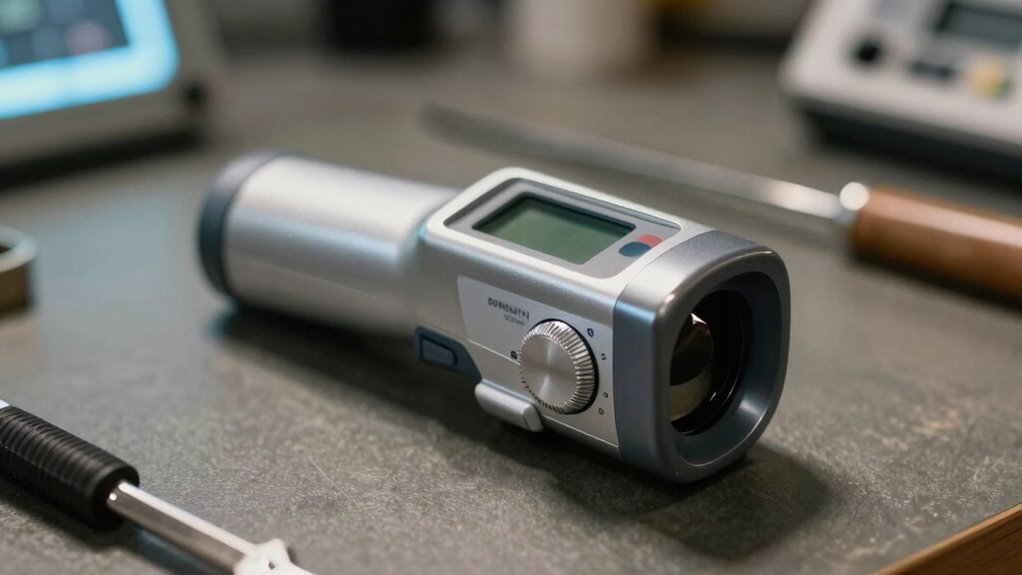
Infrared calibration plays a crucial role here. Many advanced thermometers allow you to calibrate the device to guarantee the readings stay consistent over time. Proper calibration involves setting the correct emissivity value based on the surface you’re measuring, which can vary widely between materials—from shiny metals to matte plastics. Without appropriate calibration, even a high-quality infrared thermometer can produce misleading results. Adjustable emissivity settings empower you to perform this calibration easily, ensuring that your measurements are both accurate and repeatable.
Proper calibration and adjustable emissivity ensure accurate, consistent infrared temperature measurements across various surfaces.
You might wonder why this level of control is so necessary. The answer lies in the physics of infrared radiation. Every surface has its unique emissivity coefficient, which determines how much infrared energy it emits. If you ignore this and use a generic setting, your readings might be skewed—sometimes considerably. For example, measuring a polished metal surface with a low emissivity setting can lead to underestimating the actual temperature. Conversely, using a high emissivity setting on a matte surface might cause an overestimation. By adjusting the emissivity settings appropriately, you minimize these discrepancies, leading to more trustworthy readings. Additionally, understanding the importance of infrared calibration helps in maintaining the device’s accuracy over time. A proper understanding of emissivity values is essential for accurate measurements, especially in professional or scientific contexts. Recognizing the significance of surface material differences can further improve measurement reliability. Moreover, being aware of measurement environment factors is crucial for obtaining consistent results in various conditions. Regularly verifying your device’s calibration with known reference points can also enhance measurement confidence.
Buyers care about this because it ultimately affects the quality of their work. Whether you’re monitoring equipment temperatures, checking food safety, or conducting scientific experiments, small inaccuracies can have big consequences. Adjustable emissivity thermometers give you the flexibility to adapt to different measurement scenarios quickly and accurately. They also reduce the need for multiple devices or complicated calibration procedures, streamlining your workflow.
In essence, understanding infrared calibration and mastering emissivity settings isn’t just a technical detail—it’s a practical necessity. It guarantees your temperature measurements are reliable, consistent, and meaningful across various surfaces. This capability transforms a basic infrared thermometer into a versatile tool that responds precisely to your needs, saving you time, reducing errors, and boosting confidence in your measurements. When you choose a thermometer with this feature, you’re investing in accuracy and control that will pay off in every application.

Etekcity Infrared Thermometer Laser Temperature Gun 774
- Versatile Measurement Applications: Measures objects indoors and outdoors
- High Accuracy: 12:1 distance-to-spot ratio for precise readings
- Easy to Use: Quick temperature readings on bright LCD display
As an affiliate, we earn on qualifying purchases.
As an affiliate, we earn on qualifying purchases.
Frequently Asked Questions
How Does Adjustable Emissivity Improve Temperature Accuracy in Thermometers?
Adjustable emissivity improves temperature accuracy by allowing you to fine-tune the thermometer based on material compatibility. Different surfaces have unique emissivity settings, affecting how they emit infrared radiation. By adjusting these settings, you guarantee the thermometer measures more precisely, especially for shiny or reflective surfaces. This flexibility helps you avoid errors and get consistent readings across various materials, making your measurements more reliable and accurate.
Can Adjustable Emissivity Thermometers Measure Liquids Accurately?
Over 80% of thermometers with adjustable emissivity can reliably measure liquids when you set the correct emissivity for their surface materials. By adjusting emissivity settings, you guarantee the thermometer accurately interprets the liquid’s surface radiation. This is essential because different liquids have varying emissivities. So, when you match the settings to the liquid’s surface material, you get precise temperature readings, even for challenging or reflective liquids.
What Are the Limitations of Thermometers With Adjustable Emissivity?
You should know that thermometers with adjustable emissivity have limitations related to surface reflectivity and emissivity range. If the surface reflectivity is high, it can cause inaccurate readings, even with adjustable settings. Also, the emissivity range might not cover all materials you’re measuring, leading to potential errors. These factors mean you need to be cautious and verify your thermometer’s settings match the specific surface for reliable results.
How Do I Calibrate an Adjustable Emissivity Thermometer?
Calibrating your adjustable emissivity thermometer is vital—you might as well have a superpower! Start with calibration procedures by setting the emissivity to match your target surface. Use a blackbody or a known temperature source, then compare readings, adjusting emissivity settings as needed. Repeat until your readings are accurate. Regular calibration guarantees your thermometer stays reliable, giving you precise measurements every time you need them.
Are Adjustable Emissivity Thermometers Suitable for Industrial Use?
Yes, adjustable emissivity thermometers are suitable for industrial use because they adapt to different surface properties and material compatibility. You can fine-tune the emissivity setting to match various surface types, ensuring accurate readings across diverse industrial applications. This flexibility helps you account for variations in surface properties, whether you’re measuring metals, plastics, or other materials, making these thermometers reliable tools for precise temperature monitoring in demanding environments.
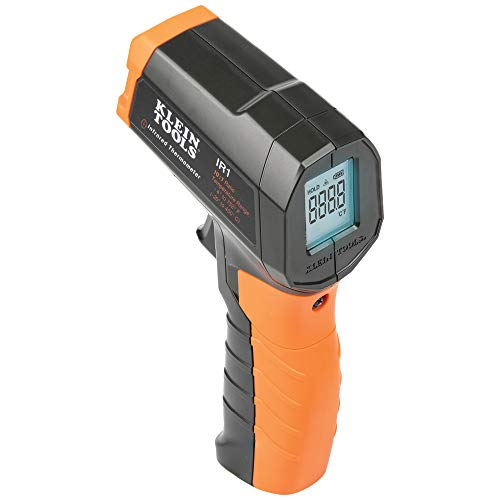
Klein Tools IR1 Infrared Thermometer, Digital Laser Gun is Non-Contact Thermometer with a Temperature Range -4 to 752-Degree Fahrenheit
- Optical Resolution: 10:1 distance-to-spot ratio
- Temperature Range: -4°F to 752°F
- Laser Targeting: Includes laser for precise aiming
As an affiliate, we earn on qualifying purchases.
As an affiliate, we earn on qualifying purchases.
Conclusion
So, next time you’re choosing a thermometer, remember the importance of adjustable emissivity. It’s funny how something so technical can make a real difference in your readings, isn’t it? When you realize that fine-tuning emissivity can give you more accurate results, it’s like discovering a secret weapon for precise measurements. Ultimately, understanding this feature isn’t just about tech—it’s about getting reliable data when it matters most. Who knew science could be so personal?

eT650D Temperature Gun by ennoLogic with NIST Certificate – Dual Laser Non-Contact Infrared Thermometer -58°F to 1202°F – Accurate Digital Surface IR Thermometer (Not for Body Temp)
- Reliable and durable accuracy: Consistent readings for years of use
- Adjustable emissivity for precision: Perfect for pizza ovens and grills
- Cost-saving home and auto repairs: Identify leaks and monitor appliance temperatures
As an affiliate, we earn on qualifying purchases.
As an affiliate, we earn on qualifying purchases.

Digital Infrared Thermometer gun for cooking,BBQ,Pizza oven,Ir Thermometer with Backlight,-58℉~932℉(-50℃~500℃) Handheld Non Contact Heat Laser Temperature Gun (Not for Human)
- Wide Temperature Range: -50℃ to 500℃ (-58℉ to 932℉)
- High Display Resolution: 0.1℃ or 0.1℉
- Unit Conversion: Switch between ℃ and ℉
As an affiliate, we earn on qualifying purchases.
As an affiliate, we earn on qualifying purchases.