Apartment balcony use demands an infrared thermometer that is compact enough to store indoors, accurate at the short distances a balcony allows, and versatile enough for a pizza oven, grill, window seals, and potted plants all in one week. The Klein Tools IR1 stands out as the best overall pick because its auto-hold function and targeting laser make one-handed readings easy when your other hand is holding tongs or a watering can. The Fluke 62 Max earns the premium spot with an IP54 rating and a three-year warranty — a meaningful step up if your balcony sees rain, wind, and temperature swings. On a budget, the Etekcity 774 covers the essentials without paying for industrial-grade durability. The main tradeoff in this category is between distance-to-spot ratio and price: wider ranges and better optics cost more, but a small balcony rarely needs them. Read on for the full breakdown of all 13 models and which one fits your setup.

Get baking supplies delivered free with Prime
- Fast, free delivery on millions of items
- Prime Video, Amazon Music and more included
- Member-only deals all year
Key Takeaways
- A 10:1 distance-to-spot ratio, like the Fluke 62 Max and Klein Tools IR1 offer, is more than enough for balcony distances — paying extra for 20:1 optics is wasted money when you are rarely more than 6–10 feet from your target.
- Adjustable emissivity, found on the Color LCD model and the calibration-focused yellow unit, was the biggest differentiator for accurate readings on shiny grill grates, glass balcony panels, and dark pizza stones.
- Most budget guns in this lineup share the same -58°F to 1112°F sensor, so spending more buys durability, warranty, and usability features — not raw temperature range.
- IP54 weather resistance on the Fluke 62 Max matters more on an exposed balcony than anywhere else indoors, where every other plastic-bodied model in the list is vulnerable to humidity.
- Rechargeable models like the -58°F to 1472°F unit trade battery anxiety for long-term convenience, but only make sense if you measure frequently; occasional users are fine with standard AAAs.
| Klein Tools IR1 Infrared Thermometer with Targeting Laser, Auto-Hold |  | Best Overall Build Quality | Temperature Range: -4°F to 752°F (-20°C to 400°C) | Distance-to-Spot Ratio: 10:1 | Emissivity: Fixed at 0.95 | VIEW ON AMAZON | See Our Full Breakdown |
| GM320 Infrared Thermometer Gun, Non-Contact Digital Surface Thermometer |  | Best for Beginners | Temperature Range: -58°F to 752°F (-50°C to 400°C) | Response Time: 0.5 seconds | Distance-to-Spot Ratio: 12:1 | VIEW ON AMAZON | See Our Full Breakdown |
| KNINE OUTDOORS Infrared Thermometer Gun, -58℉ to 1112℉ |  | Best for High-Heat Grilling | Temperature Range: -58°F to 1112°F (-50°C to 600°C) | Distance-to-Spot Ratio: 12:1 | Emissivity: Adjustable 0.1–1.0 | VIEW ON AMAZON | See Our Full Breakdown |
| Digital Infrared Thermometer Gun for Cooking, BBQ, Pizza Oven, -58℉~1112℉ |  | Best Value Pick | Temperature Range: -58°F to 1112°F (-50°C to 600°C) | Emissivity: Preset 0.95 (fixed) | Response Time: 0.5 seconds | VIEW ON AMAZON | See Our Full Breakdown |
| DESOMIYE Laser Infrared Thermometer Non-Contact Digital Temperature Gun |  | Best for Quick Everyday Checks | Temperature Range: -58°F to 1112°F (-50°C to 600°C) | Response Time: 0.5 seconds | Calibration Range: -3°C to +3°C adjustable | VIEW ON AMAZON | See Our Full Breakdown |
| Fluke 62 Max Industrial Infrared Thermometer |  | Best Premium — Built to Survive Outdoor Use | Temperature Range: -22°F to 932°F (-30°C to 500°C) | Accuracy: ±1.5°C or ±1.5% of reading | Distance-to-Spot Ratio: 10:1 | VIEW ON AMAZON | See Our Full Breakdown |
| Eventek Infrared Thermometer Gun |  | Best Value — Wide Range Without the Price Tag | Temperature Range: -58°F to 1112°F | Distance-to-Spot Ratio: 12:1 | Accuracy: ±1.5% (manufacturer claim) | VIEW ON AMAZON | See Our Full Breakdown |
| Infrared Thermometer Gun with Color LCD, Adjustable Emissivity, and K-Type Probe |  | Best Versatility — Two Tools in One Body | Temperature Range: -58°F to 1472°F (-50°C to 800°C) | Distance-to-Spot Ratio: 12:1 | Emissivity: Adjustable, 0.1–1.0 | VIEW ON AMAZON | See Our Full Breakdown |
| Rechargeable Infrared Thermometer Gun, -58°F to 1472°F |  | Best Low-Maintenance — USB-C Instead of Batteries | Temperature Range: -58°F to 1472°F (-50°C to 800°C) | Accuracy: ±2% | Distance-to-Spot Ratio: 12:1 | VIEW ON AMAZON | See Our Full Breakdown |
| Etekcity Infrared Thermometer Laser Temperature Gun 774 |  | Best for Beginners — Simplest Gun to Pick Up and Use | Temperature Range: -58°F to 842°F (-50°C to 450°C) | Distance-to-Spot Ratio: 12:1 | Recommended Distance: 14.17 inches / 36 cm | VIEW ON AMAZON | See Our Full Breakdown |
| TempPro TempScan Infrared Thermometer Gun with 2 Laser |  | Best for Balcony Grilling Precision | Temperature Range: -58°F to 1022°F | Accuracy: ±1.5% | Distance-to-Spot Ratio: 16:1 | VIEW ON AMAZON | See Our Full Breakdown |
| Ahosoutly Infrared Thermometer Laser Temperature Gun (Yellow) | 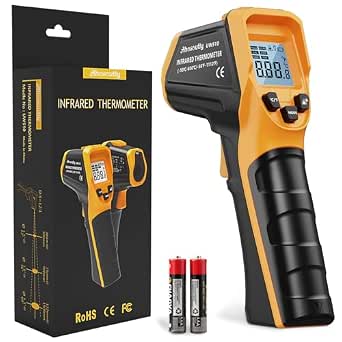 | Best for Long-Term Reading Consistency | Temperature Range: -58°F to 1112°F (-50°C to 600°C) | Response Time: 0.5 seconds | Emissivity: Adjustable | VIEW ON AMAZON | See Our Full Breakdown |
| Digital Infrared Thermometer Gun for Cooking, BBQ, Pizza Oven |  | Best Budget Starter Pick | Temperature Range: -58°F to 932°F (-50°C to 500°C) | Emissivity: Fixed at 0.95 | Resolution: 0.1°C / 0.1°F | VIEW ON AMAZON | See Our Full Breakdown |
| infrared thermometer for apartment balcony | Temperature Range | Display | Distance-to-Spot Ratio | Emissivity |
|---|---|---|---|---|
| Klein Tools IR1 Infrared Therm | -4°F to 752°F (-20°C to 400°C) | Backlit LCD | 10:1 | Fixed at 0.95 |
| GM320 Infrared Thermometer Gun | -58°F to 752°F (-50°C to 400°C) | Backlit LCD | 12:1 | Adjustable 0.1–1.0 |
| KNINE OUTDOORS Infrared Thermo | -58°F to 1112°F (-50°C to 600°C) | LCD with eye-protect design | 12:1 | Adjustable 0.1–1.0 |
| Digital Infrared Thermometer G | -58°F to 1112°F (-50°C to 600°C) | Backlit LCD with data hold | — | Preset 0.95 (fixed) |
| DESOMIYE Laser Infrared Thermo | -58°F to 1112°F (-50°C to 600°C) | Large backlit LCD | — | — |
| Fluke 62 Max Industrial Infrar | -22°F to 932°F (-30°C to 500°C) | — | 10:1 | — |
| Eventek Infrared Thermometer G | -58°F to 1112°F | Backlit LCD with data hold | 12:1 | — |
| Infrared Thermometer Gun with | -58°F to 1472°F (-50°C to 800°C) | HD color VA LCD with backlight | 12:1 | Adjustable, 0.1–1.0 |
| Rechargeable Infrared Thermome | -58°F to 1472°F (-50°C to 800°C) | — | 12:1 | Adjustable, 0.1–1.0 |
| Etekcity Infrared Thermometer | -58°F to 842°F (-50°C to 450°C) | Large backlit LCD with MAX reading | 12:1 | — |
| TempPro TempScan Infrared Ther | -58°F to 1022°F | — | 16:1 | Adjustable, 0.1–1.0 |
| Ahosoutly Infrared Thermometer | -58°F to 1112°F (-50°C to 600°C) | Backlit LCD | — | Adjustable |
| Digital Infrared Thermometer G | -58°F to 932°F (-50°C to 500°C) | Backlit LCD with data hold | — | Fixed at 0.95 |
More Details on Our Top Picks
Klein Tools IR1 Infrared Thermometer with Targeting Laser, Auto-Hold
The Klein Tools IR1 earns my top slot because it is the only model in this batch built to survive real life on a small balcony, where a thermometer gets dropped onto concrete, knocked off railings, and left out in weather. Its 6.6 ft drop protection and included carrying pouch put it a durability class above the plastic GM320 and KNINE guns. The tradeoff is specs: its 10:1 distance-to-spot ratio is the widest beam in the lineup, and its -4°F floor is 54 degrees warmer than the KNINE’s, so it cannot read freezer-level surfaces. Fixed 0.95 emissivity keeps results consistent on grills and planters, but unlike the GM320 it cannot be tuned for shiny metal. For me, reliability beats spec-sheet flex in this use case.
Pros:- 6.6 ft drop protection and jobsite-grade housing far exceed typical budget-gun durability
- Auto-hold freezes the reading so you can read it after lowering your arm
- Includes pouch and batteries out of the box
- Backlit display works for evening grilling sessions
Cons:- 10:1 distance-to-spot ratio spreads the beam wide, blurring readings of small pots or burner grates
- Cannot read below -4°F, ruling out freezer and deep-winter checks
Best for: Balcony grillers and plant owners who drop things and want one thermometer that lasts years
Not ideal for: Anyone measuring sub-zero surfaces or shiny metals, since the -4°F floor and fixed emissivity will misread both
- Temperature Range:-4°F to 752°F (-20°C to 400°C)
- Distance-to-Spot Ratio:10:1
- Emissivity:Fixed at 0.95
- Laser Targeting:Yes
- Display:Backlit LCD
- Drop Protection:6.6 ft (2 m)
- Power:Batteries included
- Included Accessories:Custom pouch
Our verdict“Buy this if you want the toughest, most dependable option for frequent balcony cooking and maintenance — skip it if you need narrow targeting or sub-zero range.”
GM320 Infrared Thermometer Gun, Non-Contact Digital Surface Thermometer
What separates the GM320 from similarly priced guns like the DESOMIYE is its adjustable emissivity (0.1–1.0), a feature usually reserved for pricier picks such as the Eventek. That matters on a balcony because you will point this at wildly different surfaces — a black grill grate, an aluminum railing, glazed ceramic pots — and one fixed setting simply cannot serve them all. The 12:1 optics also out-target the Klein IR1’s 10:1, letting you pick out a single burner from across a small space. The catch: emissivity is a double-edged sword. Set it wrong and your readings drift without warning, which makes this less foolproof than fixed-emissivity models for first-time users who never touch the settings. The 10-second auto-off saves batteries but can feel abrupt mid-task.
Pros:- Adjustable emissivity from 0.1 to 1.0 handles mixed balcony surfaces accurately
- 12:1 distance-to-spot ratio targets small zones better than the Klein IR1
- 0.5-second response time with -58°F floor covers freezer to grill
- Backlit LCD, °C/°F switch, and auto power-off simplify daily use
Cons:- Readings silently skew if emissivity is set incorrectly for the surface
- Small targets get muddy at longer distances despite the 12:1 ratio
- Surface-only measurement cannot tell you internal food temperatures
Best for: First-time buyers who want to learn surface-by-surface accuracy and don’t mind adjusting one setting
Not ideal for: Set-and-forget users who will never change emissivity and may misconfigure it without realizing
- Temperature Range:-58°F to 752°F (-50°C to 400°C)
- Response Time:0.5 seconds
- Distance-to-Spot Ratio:12:1
- Emissivity:Adjustable 0.1–1.0
- Display:Backlit LCD
- Auto Power Off:10 seconds
- Laser Pointer:Yes
Our verdict“The smartest entry point for someone who wants room to grow into accurate readings across varied surfaces.”
KNINE OUTDOORS Infrared Thermometer Gun, -58℉ to 1112℉
If your balcony setup includes a pizza oven or a grill you run screaming hot, the KNINE is the pick that will not run out of headroom. Its 1112°F ceiling matches the DESOMIYE and yellow generic guns but pairs it with adjustable emissivity and an eye-comfort LCD — a combination neither of those cheaper options offers together. Compared with the Klein IR1, you trade 300 degrees of upper range for 360 degrees more at the top end, which is exactly the right swap for a grill-focused buyer. The unit switch is clumsy, though: holding a button for three-plus seconds to flip °C to °F is an annoyance you will feel weekly. And like every fixed-emissivity sibling here, shiny stainless drip trays will read low unless you adjust for them. Orange housing is easy to spot on a cluttered shelf.
Pros:- 1112°F ceiling handles pizza stones, griddles, and charcoal grills without maxing out
- Adjustable emissivity (0.1–1.0) supports both matte and treated surfaces
- 12:1 optics allow safe standoff distance from open flames
- Low-strain display stays readable during long evening sessions
Cons:- Awkward 3-second press-and-hold to switch between °C and °F
- Lighter plastic build lacks the drop protection of the Klein IR1
- Laser-only single dot gives no visual indication of the full measurement spot
Best for: Balcony cooks running pizza ovens, searing griddles, or charcoal rigs above 750°F
Not ideal for: Occasional low-temperature users who will never use the upper range and would prefer the Klein’s tougher housing
- Temperature Range:-58°F to 1112°F (-50°C to 600°C)
- Distance-to-Spot Ratio:12:1
- Emissivity:Adjustable 0.1–1.0
- Laser:Single laser targeting
- Display:LCD with eye-protect design
- Resolution:0.1°C / 0.1°F
- Power:2 AAA batteries
Our verdict“The range king for hot-weather balcony cooking where lesser guns simply display an error.”
Digital Infrared Thermometer Gun for Cooking, BBQ, Pizza Oven, -58℉~1112℉
This yellow generic gun is the one I would hand someone who wants maximum capability per dollar: the same 1112°F range as the KNINE, a 0.5-second response, data hold, and a backlight, at the budget end of this lineup. The tradeoff versus the KNINE is control — emissivity is preset to 0.95 and locked, so shiny balcony railings, foil-lined drip pans, and polished grill lids will read artificially low unless you tape over them first. That makes it genuinely accurate on most food and griddle surfaces but misleading on metal. Versus the GM320, you give up emissivity flexibility and gain a taller temperature ceiling. The 8-second auto-off is aggressive; release the trigger and the window to note your reading closes fast. Build quality is serviceable rather than rugged — this is not the one to drop.
Pros:- Full -58°F to 1112°F range at an entry-level price point
- 0.5-second response with SCAN/HOLD display logic is easy to follow
- Backlit screen supports evening and night balcony cooking
- Runs on two cheap, widely available AAA batteries
Cons:- Fixed 0.95 emissivity misreads shiny or polished metals unless you tape over the surface
- 8-second auto-off cuts readings off quickly
- No protective case or drop rating like the Klein IR1
Best for: Budget-minded grillers who mainly measure food, griddles, and pizza stones near 0.95 emissivity anyway
Not ideal for: Anyone measuring polished metal or reflective surfaces regularly, since the locked 0.95 setting guarantees error
- Temperature Range:-58°F to 1112°F (-50°C to 600°C)
- Emissivity:Preset 0.95 (fixed)
- Response Time:0.5 seconds
- Resolution:0.1°C / 0.1°F
- Display:Backlit LCD with data hold
- Auto Power Off:About 8 seconds
- Power:2 AAA batteries (included)
Our verdict“The most temperature range you can get cheaply, as long as your targets are matte, dark, or food-friendly.”
DESOMIYE Laser Infrared Thermometer Non-Contact Digital Temperature Gun
The DESOMIYE carves out a niche the others miss: it is the easiest gun here to grab one-handed for casual spot checks — is the railing too hot to touch, has the planter soil warmed up, is the grill preheated. Its standout trick is temperature calibration offset (-3°C to +3°C), which none of the other four offer; if you notice a consistent bias against a known reference, you can correct it instead of living with it. Compared with the fixed-emissivity yellow budget gun, you give up nothing in range but the 12-second auto-off is friendlier, giving more time to jot down readings. The honest weakness is targeting: the manufacturer specifies holding it about 14 inches from the target, so it demands closer, more deliberate aim than the 12:1 KNINE or GM320 when checking anything small.
Pros:- User-adjustable calibration offset (-3°C to +3°C) corrects long-term drift
- Simple trigger-scan-release operation needs no settings knowledge
- Large backlit display reads clearly at dusk
- 12-second auto-off balances battery life with usable reading time
Cons:- Best accuracy requires roughly 14-inch working distance, limiting reach
- No stated distance-to-spot specification makes small-target precision unpredictable
- Lighter build quality than the Klein IR1 with no drop protection
Best for: Casual balcony users doing frequent quick checks on railings, pots, and appliances who value one-hand simplicity
Not ideal for: Precision tinkerers measuring small targets from across the balcony — the required close working distance limits reach
- Temperature Range:-58°F to 1112°F (-50°C to 600°C)
- Response Time:0.5 seconds
- Calibration Range:-3°C to +3°C adjustable
- Display:Large backlit LCD
- Auto Power Off:12 seconds
- Features:Data hold, °C/°F switching
- Recommended Distance:About 14 inches
Our verdict“The grab-and-go choice for everyday temperature curiosity, provided you are willing to step close to your target.”
Fluke 62 Max Industrial Infrared Thermometer
If your balcony setup means the thermometer lives outside, gets dropped on concrete, or endures dusty conditions, the Fluke 62 Max is the only option in this lineup engineered for that abuse. Its IP54 dust and splash rating and 3-meter drop tolerance are things no budget gun here can claim — the Eventek or Etekcity models would likely not survive a single hard fall onto balcony tile. The tradeoff is real, though: the 10:1 distance-to-spot ratio is narrower than the 12:1 ratios on most rivals, meaning you need to stand closer for equally precise readings. The 932°F ceiling is also lower than the 1472°F guns. What you’re paying for is repeatable professional accuracy (±1.5% or ±1.5°C) and a three-year warranty, plus min/max/average/delta logging that’s more practical for diagnosing heat sources than a single-spot readout.
Pros:- IP54 sealing and 3-meter drop resistance make it uniquely suited to exposed outdoor storage
- Min, max, average, and delta temperature displays aid real troubleshooting
- Tight ±1.5% accuracy with a three-year manufacturer warranty
- Small and clip-friendly for a belt or tool bag
Cons:- 10:1 distance-to-spot ratio forces you closer to hot surfaces than 12:1 rivals
- 932°F ceiling trails the 1112–1472°F range of cheaper competitors
- Premium price with no adjustable emissivity on this single-laser model
Best for: Apartment dwellers who keep tools outdoors year-round and want a thermometer that survives weather, drops, and long-term neglect
Not ideal for: Casual users checking a grill or pizza stone occasionally — the industrial durability and price are wasted on light balcony cooking duty
- Temperature Range:-22°F to 932°F (-30°C to 500°C)
- Accuracy:±1.5°C or ±1.5% of reading
- Distance-to-Spot Ratio:10:1
- Targeting:Single laser sighting
- Durability:Withstands 3-meter drop
- Warranty:3 years
Our verdict“This pick makes the most sense for someone who treats an infrared thermometer as a long-term outdoor tool rather than a kitchen gadget.”
Eventek Infrared Thermometer Gun
The Eventek carves out its spot by matching the specs of pricier guns at a friendlier cost: a -58°F to 1112°F range, a 12:1 distance-to-spot ratio, and a quoted ±1.5% error tolerance even at distances of a few meters. For balcony tasks like checking a pizza stone, griddle surface, or a window draft, that combination covers nearly everything the dual-probe color-LCD model offers, minus the K-type contact probe and humidity readings. Compared with the Etekcity 774, it reaches roughly 270°F higher, which matters if you ever point it at glowing coals or a pizza oven floor. The 0.5-second response and data-hold function are genuinely useful one-handed on a cramped balcony rail. The downside is a familiar one for value guns: you’re trusting an unverified accuracy claim, and there’s no calibration certificate or emissivity adjustment listed, so reflective surfaces like glass or polished metal will skew readings.
Pros:- 1112°F upper range covers pizza stones, coals, and high-heat grilling at a low price
- 12:1 ratio with laser positioning allows accurate readings from a safe distance
- Backlit night-vision LCD and data-hold function support one-handed outdoor use
- Long battery life with 10-second auto-sleep for infrequent users
Cons:- No adjustable emissivity, so reflective surfaces produce skewed readings
- Accuracy claims are manufacturer-stated without independent calibration
- Feature-dense marketing copy can make actual capability hard to verify
Best for: Budget-minded apartment cooks who want pizza-oven-capable range for balcony grilling and griddle work
Not ideal for: Anyone needing verified precision or readings on shiny metal and glass — the fixed emissivity and unconfirmed calibration make those readings unreliable
- Temperature Range:-58°F to 1112°F
- Distance-to-Spot Ratio:12:1
- Accuracy:±1.5% (manufacturer claim)
- Response Time:0.5 seconds
- Display:Backlit LCD with data hold
- Power:2 AAA batteries, up to 300 hours
- Auto-Off:10 seconds
Our verdict“A sensible pick for balcony cooks who want big-range performance without paying for industrial certification or probe extras.”
Infrared Thermometer Gun with Color LCD, Adjustable Emissivity, and K-Type Probe
This model earns its place by being the only gun in this batch with a K-type contact probe, which solves infrared’s biggest blind spot: you can’t measure internal food temperature from a distance. For balcony cooking, that means surface-scanning a griddle with the IR sensor, then switching to the probe to confirm a roast’s core temp. Add adjustable emissivity (0.1–1.0) — something the Eventek lacks — and it handles shiny pans and glass doors far more honestly than fixed-emissivity guns. The temperature, humidity, and dew point readings are a surprising bonus for diagnosing balcony condensation or draft issues. Compared with the rechargeable USB-C model, its tradeoff is power: two AAA batteries lasting around eight hours means frequent swaps if you use the backlight often, and the color LCD plus probe make it slightly more involved to operate than the dead-simple Etekcity 774.
Pros:- K-type probe adds true contact and internal temperature measurement
- Adjustable emissivity improves accuracy on metal, glass, and coated surfaces
- Humidity and dew point readings help diagnose balcony condensation problems
- Color backlit display with spoilage and temperature-difference alarms
Cons:- Around 8 hours of AAA battery life demands ongoing battery replacement
- More menus and modes than simple guns, with a learning curve
- Same 1472°F ceiling as cheaper guns despite the higher feature count
Best for: Balcony cooks and home diagnosticians who want both surface scanning and internal food temperatures from a single device
Not ideal for: Users who only need quick surface checks — the probe, alarms, and humidity readouts add cost and complexity they’ll never touch
- Temperature Range:-58°F to 1472°F (-50°C to 800°C)
- Distance-to-Spot Ratio:12:1
- Emissivity:Adjustable, 0.1–1.0
- Probe:K-type thermocouple included
- Display:HD color VA LCD with backlight
- Extra Readings:Temperature, humidity, dew point
- Power:2 AAA batteries (included), ~8 hours
- Response Time:<0.5 seconds
Our verdict“The most complete toolkit here for a buyer who wants one device for cooking, comfort checks, and surface diagnostics.”
Rechargeable Infrared Thermometer Gun, -58°F to 1472°F
If the idea of discovering dead AAA batteries every grilling season annoys you, this gun’s built-in rechargeable lithium battery with USB-C is the fix — it’s the only model in this lineup you can top up from the same charger as your phone. On paper it mirrors the color-LCD dual-probe model’s -58°F to 1472°F range and 12:1 ratio, but drops the K-type probe and humidity features in exchange for a simpler, cooking-focused experience with MAX/MIN tracking and customizable high/low alarms. Those alarms are more useful than they sound for balcony work: set a ceiling for your griddle or pizza stone and the LED warning tells you when you’ve crossed it without staring at the screen. Compared with the Eventek, you give up a little stated accuracy (±2% versus ±1.5%) but gain adjustable emissivity, which matters more in practice for mixed-material balcony surfaces.
Pros:- USB-C rechargeable battery eliminates recurring AAA costs
- Customizable high/low alarms with LED warning suit hands-off griddle monitoring
- Adjustable emissivity handles varied balcony surfaces and cookware
- MAX/MIN tracking and color backlit display in a full 1472°F-range package
Cons:- ±2% accuracy is the loosest tolerance in this batch
- Needs a full charge before first use, so no instant out-of-box session
- Surface readings only — no contact probe for internal temperatures
Best for: Occasional balcony grillers who hate battery swaps and want set-and-forget temperature alarms
Not ideal for: Precision-minded users — the ±2% accuracy rating trails several rivals, and it can’t measure internal food temperature
- Temperature Range:-58°F to 1472°F (-50°C to 800°C)
- Accuracy:±2%
- Distance-to-Spot Ratio:12:1
- Emissivity:Adjustable, 0.1–1.0
- Power:Rechargeable lithium battery, USB-C
- Response Time:0.5 seconds
- Special Features:MAX/MIN, high/low alarms, LED warning, auto shutdown
Our verdict“The right choice for a set-it-and-check-it balcony cook who values charging convenience and alarms over maximum precision.”
Etekcity Infrared Thermometer Laser Temperature Gun 774
The Etekcity 774 is the model I’d hand to someone buying their first infrared thermometer. There are no emissivity settings to misconfigure, no probe ports, no menus — just point, pull the trigger, and read. Its averaged-surface reading is a genuine benefit for beginners: rather than a single-point number that shifts as your hand wobbles, it reports the average across the targeted circle, which steadies results on a balcony griddle where the heat isn’t uniform. The large backlit LCD is easier to read at a glance than smaller rivals in fading evening light. The compromises are equally clear: the 842°F ceiling is the lowest here, ruling out direct reads on pizza-oven domes or coals (the Eventek and both 1472°F guns handle those), and the fixed emissivity means shiny stainless surfaces will read low. Batteries are included, which keeps the first-use friction near zero.
Pros:- No-setup operation with trigger-based scanning anyone can use immediately
- Averaged-surface readings smooth out uneven griddle and pan temperatures
- Bright, large backlit display readable in low light
- Batteries included and sub-half-second results
Cons:- 842°F maximum is the lowest range in this roundup
- Fixed emissivity makes reflective metal and glass readings unreliable
- No adjustable alarms, data logging, or probe capability
Best for: First-time buyers doing everyday balcony grilling, oven, fridge, and AC vent checks who want zero setup
Not ideal for: High-heat cooks — anything above 842°F, like pizza stones or charcoal beds, maxes out this range
- Temperature Range:-58°F to 842°F (-50°C to 450°C)
- Distance-to-Spot Ratio:12:1
- Recommended Distance:14.17 inches / 36 cm
- Response Time:<0.5 seconds
- Display:Large backlit LCD with MAX reading
- Power:2 AAA batteries (included)
Our verdict“The easiest entry point for casual balcony temperature checks, as long as your cooking never exceeds mid-range heat.”
TempPro TempScan Infrared Thermometer Gun with 2 Laser
For a small balcony setup where you’re standing close to a hot grill or pizza oven, the TempPro TempScan makes the most sense because of its adjustable emissivity (0.1–1.0) and dual-laser targeting. That combination matters more here than raw range: grates, cast iron, and pizza stones all radiate heat differently, and a fixed-emissivity unit like the GM320 will drift off the mark on those mixed surfaces. The dual lasers frame your measurement spot instead of just pointing at its center, which helps when you’re aiming at a narrow grill grate from an awkward angle on a cramped balcony. Its MAX/MIN/AVG tracking also lets you confirm your stone has stopped climbing before you launch a pizza. The tradeoff is the 1,022°F ceiling — lower than the 1,112°F you get from the KNINE OUTDOORS — and the plastic housing won’t shrug off a drop onto concrete the way the IP54-rated Fluke 62 Max would.
Pros:- Adjustable emissivity from 0.1 to 1.0 gives accurate readings across grates, stones, and seasoned cast iron
- Dual-laser targeting frames the exact measurement spot, helpful for small grill surfaces
- 16:1 distance-to-spot ratio plus 0.5s response lets you read hot surfaces without leaning over the grill
- MAX/MIN/AVG mode tracks temperature stabilization on pizza stones and griddles
- ±1.5% accuracy rating is tighter than most budget guns in this class
Cons:- 1,022°F upper limit trails the 1,112°F models for high-heat oven work
- All-plastic build feels less durable for outdoor use than ruggedized options like the Fluke 62 Max
Best for: Balcony grillers and pizza oven owners who need accurate readings across different cookware surfaces from close range
Not ideal for: Anyone measuring shiny metals regularly — you’ll fight reflective-surface error unless you use tape tricks, and industrial users will want a tougher housing
- Temperature Range:-58°F to 1022°F
- Accuracy:±1.5%
- Distance-to-Spot Ratio:16:1
- Emissivity:Adjustable, 0.1–1.0
- Response Time:0.5 seconds
- Targeting:Dual laser
- Battery:2 AAA (included)
- Length:6.57 inches
Our verdict“This pick makes the most sense for the balcony cook who cares about reading the right surface accurately rather than chasing the highest temperature ceiling.”
Ahosoutly Infrared Thermometer Laser Temperature Gun (Yellow)
What separates the Ahosoutly from the budget pack is its one-button CAL calibration function, a feature almost never found at this tier. Cheap infrared guns tend to drift over months of balcony use — repeated heat exposure and temperature swings accelerate that. Being able to recalibrate means your griddle readings in October match your readings in April, which matters if you’re dialing in a repeatable searing routine. Compared with the single-laser TempPro TempScan, the Ahosoutly covers a wider 1,112°F range (matching the KNINE OUTDOORS) and adds adjustable emissivity alongside the calibration, so it’s arguably the more future-proof tool. The bright yellow housing is also harder to misplace among grill tools at dusk. On the downside, the listing doesn’t specify a distance-to-spot ratio, so expect a fairly wide measurement cone — from across a balcony you’ll be averaging surrounding air and railing into your reading, and it lacks the dual-laser framing that makes aiming precise.
Pros:- One-button CAL calibration counters the sensor drift common in cheaper guns
- Wide -58°F to 1112°F range covers everything from fridge checks to pizza oven duty
- Adjustable emissivity plus MIN/MAX tracking for monitoring heat fluctuations
- High-visibility yellow body is easy to spot among dark grill accessories
- Backlit LCD and low-battery indicator are practical for evening cookouts
Cons:- No published distance-to-spot ratio, making targeted readings at range unreliable
- Single-point laser is less precise for framing small spots than the TempPro’s dual-laser setup
- Unbranded sensor means accuracy claims rest on the calibration feature rather than a stated tolerance
Best for: Seasoned balcony cooks who log temperatures over time and want readings that stay consistent across seasons
Not ideal for: Anyone who needs to measure small targets from a distance — the unspecified distance-to-spot ratio means a wide measurement area at range
- Temperature Range:-58°F to 1112°F (-50°C to 600°C)
- Response Time:0.5 seconds
- Emissivity:Adjustable
- Calibration:One-button CAL function
- Display:Backlit LCD
- Battery:2 AAA (included)
- Body Material:ABS plastic
- Auto Shutoff:Yes
Our verdict“Choose this one if long-term consistency and a wide temperature range matter more to you than precision aiming at small targets.”
Digital Infrared Thermometer Gun for Cooking, BBQ, Pizza Oven
This no-name basic infrared gun is the one to grab if you’re new to balcony cooking and don’t want to spend much before knowing whether you’ll actually use a thermometer. It does the fundamentals honestly: point, pull the trigger, read the backlit LCD, and the reading holds when you release. Its simplicity is also its limitation. The emissivity is fixed at 0.95 — fine for pizza stones and most food surfaces, but wrong for shiny stainless grill lids, and unlike the TempPro TempScan there’s no way to adjust it; the manual literally suggests covering reflective targets with tape. Its 932°F ceiling is the lowest in this roundup, short of the 1,112°F Ahosoutly, though still enough for most griddle and BBQ work. The 8-second auto shutoff saves batteries but can feel abrupt mid-task. Compared with the Etekcity 774, this unit strips away adjustable emissivity and data logging, so treat it as a learning tool rather than a precision instrument.
Pros:- Simple trigger-and-hold operation with SCAN/HOLD display, genuinely beginner-friendly
- Backlit screen with °C/°F toggle handles evening cookouts
- 0.1° resolution gives finer readouts than expected at this price
- 8-second auto shutoff stretches AAA battery life
Cons:- Fixed 0.95 emissivity produces inaccurate readings on shiny metals with no way to correct it
- 932°F upper limit is the lowest here, limiting high-heat pizza oven use
- No adjustable emissivity, calibration, or MAX/MIN tracking unlike the TempPro or Ahosoutly
Best for: First-time balcony grillers who want a cheap, simple gun for occasional pizza stone and griddle temperature checks
Not ideal for: Anyone measuring reflective or polished metal surfaces, or pushing past 932°F — the fixed emissivity and lower ceiling will fight you
- Temperature Range:-58°F to 932°F (-50°C to 500°C)
- Emissivity:Fixed at 0.95
- Resolution:0.1°C / 0.1°F
- Display:Backlit LCD with data hold
- Auto Shutoff:Approx. 8 seconds
- Battery:2 AAA (included)
- Operation:Non-contact, not for human temperature
Our verdict“A sensible low-risk first thermometer for casual balcony cooks, as long as you accept its fixed emissivity and lower temperature ceiling.”

How We Picked
I ranked these 13 thermometers against the realities of apartment balcony use rather than raw spec sheets. The criteria that mattered most: accuracy at close range (balcony measurements happen at 2–10 feet, so distance-to-spot ratio had to be adequate but not excessive), usability one-handed (backlit displays, auto-hold, and readable screens while holding food or tools), versatility across tasks (grilling, pizza ovens, HVAC vents, window drafts, plant soil temperature), and storage and portability since every one of these lives indoors when not in use.
Durability and weather resistance became the tiebreaker at the top of the list — an exposed balcony is harder on electronics than a kitchen drawer. I also weighted emissivity control heavily, because reflective and glass surfaces common on balconies produce misleading readings on fixed-emissivity guns. Price was judged on value delivered, not on being cheap: a model earns its place by solving a balcony-specific problem, not by undercutting the competition.
| infrared thermometer for apartment balcony | Emissivity | Display |
|---|---|---|
| Klein Tools IR1 Infrared Therm | Fixed at 0.95 | Backlit LCD |
| GM320 Infrared Thermometer Gun | Adjustable 0.1–1.0 | Backlit LCD |
| KNINE OUTDOORS Infrared Thermo | Adjustable 0.1–1.0 | LCD with eye-protect design |
| Digital Infrared Thermometer G | Preset 0.95 (fixed) | Backlit LCD with data hold |
| DESOMIYE Laser Infrared Thermo | — | Large backlit LCD |
| Fluke 62 Max Industrial Infrar | — | — |
| Eventek Infrared Thermometer G | — | Backlit LCD with data hold |
| Infrared Thermometer Gun with | Adjustable, 0.1–1.0 | HD color VA LCD with backlight |
| Rechargeable Infrared Thermome | Adjustable, 0.1–1.0 | — |
| Etekcity Infrared Thermometer | — | Large backlit LCD with MAX reading |
| TempPro TempScan Infrared Ther | Adjustable, 0.1–1.0 | — |
| Ahosoutly Infrared Thermometer | Adjustable | Backlit LCD |
| Digital Infrared Thermometer G | Fixed at 0.95 | Backlit LCD with data hold |
Factors to Consider When Choosing Infrared Thermometer For Apartment Balcony
Before picking a model from the list above, it helps to understand what actually changes your reading quality on a balcony — because several of these factors are ones buyers overlook until the first misleading number appears.Distance-to-Spot Ratio: Why More Is Not Always Better
The distance-to-spot ratio tells you how big an area the thermometer averages at a given distance. A 12:1 ratio means that at 12 feet, you are measuring a one-foot circle — fine for a grill grate or AC unit, useless for a single plant leaf. Balcony work rarely happens beyond 10 feet, which means most models in this list are overqualified on this spec. The mistake buyers make is paying for 20:1 or 30:1 optics designed for industrial ductwork they will never access. What actually matters more on a balcony is the minimum measurable area: if you want to check a small potted plant or a thin window gap, a tight spot at close range beats an impressive long-range ratio. Read the spec from the balcony’s perspective, not the spec sheet’s.
Emissivity: The Hidden Cause of Wrong Readings
Emissivity determines how well a surface radiates heat, and shiny materials like stainless grill grates, aluminum railings, and glass panels radiate poorly — which fools fixed-emissivity thermometers into reading dramatically low. Most budget guns assume a 0.95 emissivity suited to matte, organic surfaces like pizza stones and food. If your balcony checks involve metal or glass, a model with adjustable emissivity will produce numbers you can trust; fixed models will still work but require a workaround, like placing a piece of matte tape on the surface and measuring that. This is the single most common reason new owners conclude their thermometer is broken. Decide up front whether you will accept the tape trick or want native control, because this feature separates the mid-range models from the budget tier more than any other.
Weather Exposure and Build Quality
An apartment balcony is a semi-outdoor environment: humidity, temperature swings, morning condensation, and the occasional splash from cleaning. Most consumer thermometer guns use sealed-but-not-rated plastic bodies that tolerate occasional outdoor use if brought back inside afterward — which is the realistic workflow for nearly everyone. The step up is an IP54-rated housing, which resists dust and water spray, and that rating is why the Fluke sits at the premium end of this list. Be honest about your habits: if the thermometer will live in a balcony storage box through a humid summer, rating matters. If it goes back to a kitchen drawer every time, standard build quality is sufficient and the money is better spent elsewhere. Also check the battery door seal — it is the first failure point on cheap units in damp conditions.
Temperature Range: Matching the Range to Real Balcony Tasks
Nearly every gun in this roundup covers -58°F to 1112°F, which handles balcony grilling, pizza ovens, HVAC vents, and cold drafts with room to spare. The two questions that should shape your choice: do you ever need above 1112°F (only relevant for serious Neapolitan pizza steel or forge-adjacent hobbies, where the 1472°F models earn their spot), and do you need the low end for winter plant monitoring? A wider range sometimes comes with slightly coarser resolution, meaning the displayed number jumps in larger steps. For food and HVAC, readings in one-degree increments matter more than an extreme ceiling. Range is the most advertised spec and the least differentiating one in this category — treat it as a checkbox, not a buying reason.
Power Source and Daily Convenience
Most guns here run on disposable AA or AAA batteries, which last a long time for occasional use but die at the worst moment — usually mid-pizza-cook. A rechargeable model with a lithium battery removes that annoyance and suits anyone measuring several times a week, though it introduces its own failure mode: a battery that self-discharges in a drawer over a winter. Laser and backlight settings drain batteries faster than people expect, so an auto-off function is a genuinely useful feature rather than a gimmick. Think about how often you will actually reach for the thermometer. Daily users benefit from recharging; weekend grillers are better served by a model whose batteries can be swapped in ten seconds from the kitchen drawer.
Display Readability Outdoors
Balcony readings often happen in bright daylight or after dark, and both conditions defeat a poor display. A dim LCD that works fine in a kitchen becomes unreadable in direct sun — glare washing out the digits entirely — while a weak backlight fails at night. Models with backlit screens and decent contrast handle the dark end; a few offer color LCDs that perform better in mixed light. This is also where auto-hold earns its keep: if you cannot see the screen while aiming at an awkward angle under a railing, a hold function lets you point, click, then read at a comfortable angle. Do not assume all backlights are equal — brightness and digit size vary meaningfully across this list, and it is the kind of small frustration that compounds with every use.
Frequently Asked Questions
Can I use a balcony infrared thermometer to check my grill and my air conditioning vent with the same device?
Yes, and that dual use is exactly why infrared guns suit apartment living — one tool covers cooking, HVAC, and even window-draft checks. The catch is emissivity: a matte grill grate reads fairly accurately on a standard fixed setting, while a shiny metal AC vent or reflective duct can read low by a surprising margin. If both tasks matter to you, lean toward a model with adjustable emissivity, or keep matte tape on hand to place over shiny surfaces before measuring. Also remember the spot size: at close range both targets are easy to hit accurately, so distance is rarely the problem in balcony HVAC checks. The people who get frustrated with one-device-for-everything setups are almost always hitting an emissivity issue, not a device defect.
Is an infrared thermometer accurate enough for pizza on a balcony oven?
For most balcony pizza work, yes — these guns measure surface temperature, which is exactly what matters for a pizza stone or steel. You will get a reliable reading of the stone’s surface before launch, which is the number that determines crust browning. Two caveats: aim at the stone, not the open flame, since the flame’s radiant output can skew the reading, and accept that the reading reflects a spot, not the whole stone, so sweeping across the surface gives you a more useful picture. If you chase very high steel temperatures above 1112°F, you will need one of the 1472°F models in this list. For standard balcony ovens, any gun here is accurate enough as long as you measure the right target.
Why does my infrared thermometer give a different reading than my grill’s built-in thermometer?
Because they are measuring different things, and the discrepancy is usually a sign both are working. A built-in grill thermometer reads the air temperature near the lid, while an infrared gun reads the surface temperature of the grate or the food itself — and those numbers can easily differ by 50°F or more during preheating. The grate surface is what actually cooks your food through contact, so the infrared reading is usually the more useful one for timing. Emissivity also plays a role: shiny or new grates can read low until seasoned with use. Rather than treating one as wrong, use the lid thermometer for ambient trends and the gun for surface truth, and you will cook more consistently than with either alone.
Do I need an IP54 rating if my thermometer is only used outdoors briefly?
Probably not, and for most balcony users the honest answer is that a standard plastic body held outdoors for thirty seconds at a time will be fine. The rating earns its premium when the device faces repeated exposure — stored in a balcony box, used in coastal humidity, or grabbed with wet hands near a rain-soaked railing. Condensation is the silent killer: a gun carried from a cold balcony into a warm apartment can develop internal moisture over months, which no budget housing resists. If your routine is grab, measure, return indoors, spend the savings on better features instead. If your thermometer lives semi-permanently outdoors, the sealed housing is cheap insurance against a season-shortened lifespan.
Are the cheap generic infrared guns in this list basically the same product?
Many of them share very similar internals — the recurring -58°F to 1112°F range across multiple listings is a strong hint that the same sensor module appears under different brand names. That is not automatically bad: the underlying sensor is competent for balcony tasks, and a generic gun can be a perfectly sound budget choice. What differs are the supporting details: laser quality, display brightness, button feel, battery door fit, warranty support, and occasionally emissivity adjustment. Brand-name models justify their premium through consistency and after-sales support, which matters if a unit arrives miscalibrated. My advice is to choose generics on features you can verify in the listing — adjustable emissivity, backlight, hold function — and not on brand familiarity alone.
Conclusion
For best overall, the Klein Tools IR1 balances accuracy, one-handed auto-hold operation, and durable construction at a price that makes sense for a tool you will use weekly on a balcony. The Fluke 62 Max is the best premium pick — its IP54 rating and three-year warranty justify the spend only if your thermometer faces real weather exposure or you want a device that outlasts several cheaper guns. For best value, the Etekcity 774 delivers dependable readings and a readable display without the industrial markup, making it the smart default for occasional grillers and draft-hunters. Beginners should start with the Eventek or one of the straightforward -58°F to 1112°F generics: simple controls and forgiving operation teach you the tool before you pay for features. For specific needs, the 1472°F models with adjustable emissivity and color displays suit high-heat pizza enthusiasts and anyone measuring glass or metal railings, while the rechargeable model fits daily users tired of battery swaps. Match the pick to how — and how often — you will actually use it, and every option here can earn its place on your balcony.
Halloween Picks
halloween
As an affiliate, we earn on qualifying purchases.