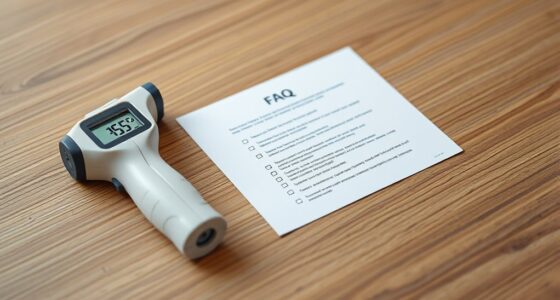
Using infrared thermometers to check stone temperatures allows you to quickly and non-invasively measure surface heat, helping you assess structural integrity, identify hot spots, or monitor temperature distribution. To get accurate results, make sure your device is properly calibrated and adjust the emissivity based on the stone’s surface conditions. Be consistent with your measurement distance and angle for reliable data. Keep exploring to learn how thermal imaging can further enhance your temperature assessments.

Get baking supplies delivered free with Prime
- Fast, free delivery on millions of items
- Prime Video, Amazon Music and more included
- Member-only deals all year
Key Takeaways
- Select an infrared thermometer with adjustable emissivity settings suitable for stone surfaces.
- Keep a consistent measurement distance and angle to ensure accurate temperature readings.
- Calibrate the device regularly according to manufacturer instructions for precise results.
- Adjust emissivity settings based on surface conditions like coatings or moisture for better accuracy.
- Use thermal imaging to visualize temperature variations and identify hot spots or anomalies on stones.

Infrared thermometers have become essential tools for accurately measuring the surface temperatures of stones without direct contact. Whether you’re assessing the temperature of a heated monument, a construction material, or a natural rock formation, these devices offer quick and reliable readings. When using infrared thermometers, understanding the role of thermal imaging can considerably enhance your ability to interpret temperature data. Thermal imaging allows you to visualize temperature variations across a stone’s surface, revealing hot spots or cooler areas that might not be apparent with a single-point measurement. This capability is particularly useful when inspecting large or uneven stones, where temperature distribution matters.
Thermal imaging enhances stone temperature analysis by revealing surface variations and hot spots.
However, to guarantee your measurements are precise, proper temperature calibration of your infrared thermometer is essential. Calibration involves adjusting the device so that its readings align with a known standard, minimizing errors caused by device drift or environmental factors. Regular calibration ensures consistency, especially if you’re using the thermometer over extended periods or across different projects. Most infrared thermometers come with a calibration certificate or require periodic calibration checks, which you should perform according to the manufacturer’s guidelines. Proper calibration is important because even slight inaccuracies can lead to misjudging the thermal state of a stone, affecting your analysis or safety decisions.
When checking stone temperatures, take care to account for surface emissivity, which is a material’s ability to emit thermal radiation. Stones typically have high emissivity, but variations can occur depending on surface coatings or moisture levels. Adjust your infrared thermometer’s emissivity setting accordingly to obtain accurate readings. Keep in mind that thermal imaging can help you identify temperature anomalies across an entire surface, providing an extensive overview that single-point measurements might miss. This is especially useful when trying to detect heat loss, structural flaws, or thermal stress within large stone structures. Additionally, vetted infrared thermometers are often more reliable and offer better calibration options, ensuring your measurements remain accurate over time.
Consistency is key when using infrared thermometers for stone temperature assessment. Always aim to measure from the same distance and angle, and allow the device to stabilize before recording a reading. Combining thermal imaging with proper temperature calibration will give you a clearer, more accurate picture of the stone’s thermal condition. Whether for maintenance, research, or safety inspection, mastering these techniques ensures you get reliable data, saving time and preventing costly errors. In brief, understanding thermal imaging and maintaining accurate temperature calibration are essential steps to effectively use infrared thermometers in your stone temperature evaluations.
infrared thermometer for stone surfaces
As an affiliate, we earn on qualifying purchases.
As an affiliate, we earn on qualifying purchases.
Frequently Asked Questions
Can Infrared Thermometers Measure Internal Stone Temperatures?
No, infrared thermometers can’t measure the internal temperature of stone. They work by capturing surface measurement, which means you only get the external temperature. If you need to know the internal temperature, you’ll need to use a probe thermometer or other specialized tools. Infrared devices are great for quick surface checks, but they don’t penetrate the material to provide an internal temperature reading.
How Do Ambient Conditions Affect Infrared Thermometer Accuracy?
Ironically, ambient conditions don’t always cooperate with your infrared thermometer’s accuracy. Environmental interference like dust, humidity, or direct sunlight can distort readings, making them unreliable. You also need to take into account surface emissivity; if it’s off, you’ll get skewed temperatures. So, in unpredictable conditions, your trusty tool might give you a false sense of precision, reminding you that external factors often matter more than you’d like.
What Is the Optimal Distance-To-Spot Ratio for Stone Measurements?
You should aim for a distance-to-spot ratio of at least 12:1 when measuring stone temperatures. This ratio guarantees measurement accuracy by allowing you to keep a safe distance while accurately targeting the specific spot. Staying within this ratio minimizes errors caused by surrounding surfaces or heat radiation, so follow the manufacturer’s guidelines carefully. Proper distance helps you obtain precise temperature readings and ensures reliable results.
Are There Any Safety Concerns When Using Infrared Thermometers on Stones?
When using infrared thermometers on stones, safety concerns are minimal, but you should still consider material safety and proper device handling. Avoid pointing the device at your eyes or others, and verify the thermometer is in good condition to prevent malfunctions. Handle the device carefully to prevent damage, and follow manufacturer instructions. While stones pose no significant safety risk, always stay cautious to ensure accurate readings and safe operation.
How Often Should Infrared Thermometers Be Calibrated for Accurate Readings?
You should calibrate your infrared thermometer at least once a year to guarantee measurement consistency. If you notice discrepancies or use it frequently in demanding conditions, consider more frequent calibrations, such as every six months. Regular calibration helps maintain accuracy, preventing errors in temperature readings on stones. Always follow the manufacturer’s recommendations for calibration frequency, and keep records to track when each calibration was performed for maximum reliability.
thermal imaging camera for construction
As an affiliate, we earn on qualifying purchases.
As an affiliate, we earn on qualifying purchases.
Conclusion
Using infrared thermometers is like having a window into your stones’ health—quick, precise, and non-invasive. I once checked a stone’s temperature before and after a heating session, noticing a clear difference that saved me from overcooking. Just as a doctor uses a thermometer to catch a fever early, you can catch potential issues early with accurate readings. Trust these tools—they’re your best friends in keeping your stones safe and performing at their best.
adjustable emissivity infrared thermometer
As an affiliate, we earn on qualifying purchases.
As an affiliate, we earn on qualifying purchases.
professional stone temperature measurement device
As an affiliate, we earn on qualifying purchases.
As an affiliate, we earn on qualifying purchases.
Halloween Picks
halloween
As an affiliate, we earn on qualifying purchases.