TL;DR

Get baking supplies delivered free with Prime
- Fast, free delivery on millions of items
- Prime Video, Amazon Music and more included
- Member-only deals all year
Good Housekeeping has published six ideas for giving vintage teacups new uses, including a cake stand, bird feeder, trinket dish, miniature scene, candle and succulent garden. The suggestions are craft and decor guidance, not a report of a new product or scientific finding; readers should follow adhesive instructions and account for drainage, fire safety and wildlife needs.
Good Housekeeping has outlined six ways to give vintage teacups a second use, from making a bird feeder or candle to assembling a miniature garden. The guide offers craft ideas for people with inherited or thrifted cups, while practical details such as safe materials, outdoor placement and care vary by project.
The six ideas in the report range from functional projects to decorative displays: attach a teacup to a plate to create a small cake stand; pair a cup and saucer as a bird feeder; decorate a cup as a trinket dish with rhinestones; build a miniature scene inside it; pour a candle into it; or plant small succulents in it. The report presents these as ways to reuse objects that might otherwise sit unused, rather than as a single coordinated project or product launch.
For the cake stand, designer Janette Ewen recommends cleaning the cup and plate with rubbing alcohol, applying ceramic glue around the cup’s base, pressing the plate onto it and allowing the glue to cure for 24 hours. Ewen says the pieces do not need to match. The report does not specify whether the finished stand is suitable for direct food contact, so readers should check the adhesive’s label and use a separate food-safe plate or liner if needed.
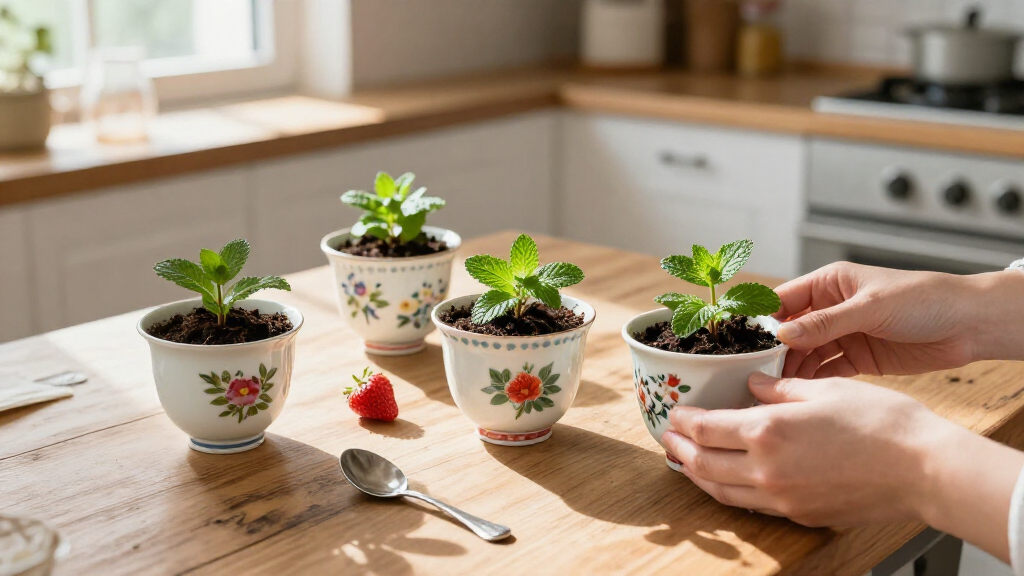
For a feeder, professional organizer Blanka Molnar suggests gluing the cup and saucer in a position that lets seed spill from the cup, then placing the assembly on a flat surface or hanging it by its handle. Crafting expert Amanda Middleton describes rhinestone decoration as a way to turn a cup into a dish for jewelry or small supplies. Ewen’s miniature display uses flower foam, moss and small decorative objects. The remaining options are to pour a candle into the cup or plant one or two succulents in cactus potting mix over a layer of rocks.
Practical Uses for Unused Cups
The guide speaks to a familiar household problem: vintage teacups are often inherited or found secondhand, but sets may be incomplete or too delicate for routine use. Repurposing offers another option besides storing or discarding them, and the six suggestions range from simple display projects to objects with an everyday function.
The ideas also call for different levels of care. A decorative miniature scene is not used like a candleholder or serving stand, and the materials that make a project attractive do not automatically make it safe for every use. Readers should check product directions for adhesives and candle supplies, and treat a glued stand as a craft item unless its materials are suitable for serving food. For planting, drainage and the cup’s size affect how well the arrangement can be maintained.
The broader value is modest but useful: the report turns a decorative object into a starting point for creative reuse. It does not establish that any one project saves money, reduces waste by a measurable amount or suits every cup. The condition and design of the individual piece matter, especially if it has cracks, a loose handle or sentimental value.
Products Worth Considering

Ninja Luxe Café Mini Plus with AutoFroth – Bone & Champagne

De'Longhi COM530M All-in-One Coffee and Espresso Machine, 47 oz

Vitamix Nano Personal Blender with SmoothiePilot, Black
As an affiliate, we earn on qualifying purchases.
Six Projects in the Good Housekeeping Guide
The source is a Good Housekeeping report titled “6 Perfectly Charming Ways to Upcycle Vintage Teacups.” Its framing is based on the availability of older cups at thrift stores and in people’s homes, as well as the possibility that owners may have inherited them. The supplied material gives no publication date, market data or claim that teacup reuse is a new trend.
The report attributes advice to three contributors: designer Janette Ewen, professional organizer Blanka Molnar and crafting expert Amanda Middleton, identified as a co-founder of Bluestreak Crystals. Their comments accompany specific projects rather than serving as independent testing of the finished objects. The article also describes a “gem-maxxing” approach—covering everyday objects with rhinestones or flatback crystals—as a decorative option for the trinket dish.
Each proposal uses the cup’s small scale differently. The cake stand and bird feeder combine a cup with its saucer or another plate; the miniature setting, candle and succulent garden use the cup as a container; and the jeweled trinket dish treats its shape as a display surface. The source includes basic craft steps, but it does not provide a full materials list or detailed safety evaluation for every project.
““Don’t worry about matching patterns; the mismatched, shabby-chic look is part of the charm.””
— Janette Ewen, designer
Materials and Safety Details
The supplied report does not name a specific ceramic glue for the cake stand or provide testing on how much weight the finished assembly can hold. It also does not say whether that glue is suitable for contact with food, or whether the stand should be used only for display. Readers need to follow the product label, including curing time and any limits on use.
The bird-feeder instructions do not specify seed types, cleaning frequency, hanging hardware or how to protect the feeder from weather and animals. The candle suggestion likewise lacks details about wick size, wax quantity, safe placement and supervision. Those are practical questions that depend on materials and setup; the article’s brief craft description should not be treated as a complete safety guide.
For the succulent arrangement, the report recommends rocks and cactus potting mix but does not explain whether the cup needs a drainage hole or how to manage excess water. A teacup that cannot drain may require careful watering. It is also unclear whether each idea suits every vintage cup, particularly pieces with existing damage, fragile decoration or sentimental significance.
Check Supplies Before Starting
The source does not announce a follow-up, product release or event. For readers planning a project, the next step is to choose one use based on the cup’s condition and the materials available, then check instructions for adhesives, candle-making supplies or plant care before assembling it. The cake-stand instructions specify a 24-hour curing period; users should follow the actual adhesive packaging if it gives different directions.
Anyone adapting the bird-feeder idea can decide whether a stable surface or a securely fastened hanging arrangement is appropriate for the location, and can check local guidance on feeding wildlife. For candle and planting projects, safe placement and water management will depend on the chosen materials and the cup itself. The report offers starting points; it does not confirm that the projects have been tested for every household setting.
Key Questions
What are the six ways to reuse a vintage teacup?
The Good Housekeeping guide suggests a cake stand, bird feeder, rhinestone trinket dish, miniature scene, candle and succulent garden.
How long should the teacup cake stand glue cure?
The report says to let the ceramic glue cure for 24 hours before turning the stand over. Follow the adhesive manufacturer’s instructions, which may include additional requirements.
Can a glued teacup stand be used for food?
The source does not confirm that the glue is food-safe or that the completed stand is suitable for direct food contact. Check the product label and use a separate food-safe surface if you are unsure.
Can I plant succulents directly in a teacup?
The guide suggests rocks, cactus potting mix and one or two small succulents. It does not specify a drainage hole, so take care with watering if the cup cannot drain.
Source: goodhousekeeping.com