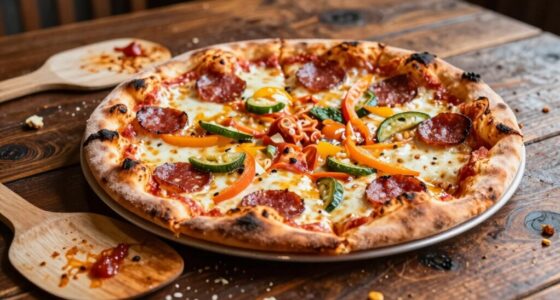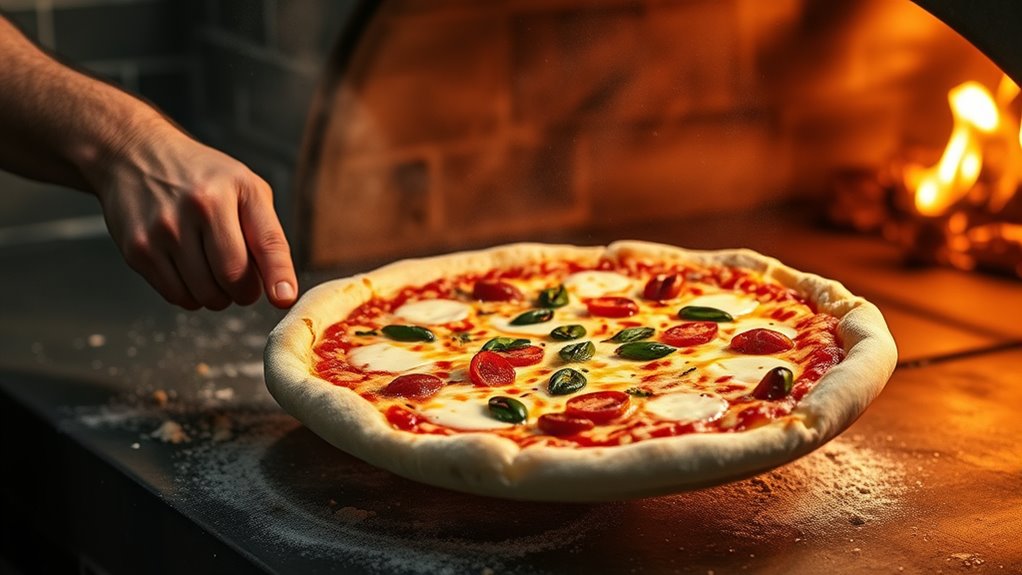

To slide your pizza smoothly onto the stone, position the pizza on a well-floured or cornmealed peel, then give it a gentle shake to check for sticking. Hold the peel at a slight angle, then use a quick, confident wrist jerk to launch the pizza onto the preheated stone. Practice helps you perfect timing and technique, ensuring a crisp crust and even cook every time. Keep mastering these steps to elevate your pizza-making skills further.

Get baking supplies delivered free with Prime
- Fast, free delivery on millions of items
- Prime Video, Amazon Music and more included
- Member-only deals all year
Key Takeaways
- Use a well-floured or cornmeal-dusted peel to prevent sticking during transfer.
- Position the peel at a slight angle to the stone before executing a quick, confident wrist jerk.
- Give the pizza a gentle shake on the peel to test it moves freely before launching.
- Ensure the dough is properly proofed and not overly sticky for easier sliding.
- Launch with a swift, smooth motion to allow the pizza to glide onto the stone evenly.
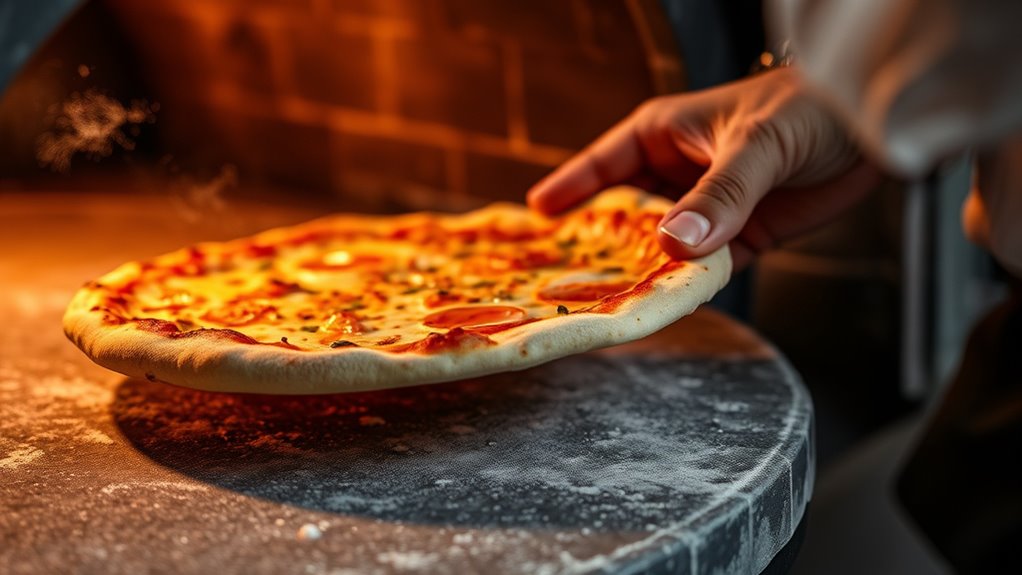
Have you ever wondered what makes a launch successful? When it comes to sliding pizzas smoothly onto the stone, the key lies in technique and preparation. You want your pizza to land perfectly in the oven, ensuring even cooking and a crispy crust. To do that, you need to focus on pizza safety and oven temperature, because both play essential roles in a successful launch. Maintaining the right oven temperature is essential; a hot oven, ideally between 475°F and 500°F, guarantees that your pizza cooks quickly and evenly once it hits the stone. If the oven isn’t hot enough, your pizza might turn out soggy or undercooked. Conversely, if it’s too hot, the crust could burn before the toppings are ready. Hence, preheating the oven properly and ensuring the stone reaches the best temperature is your first step.
A hot oven between 475°F and 500°F ensures perfectly cooked, crispy pizza every time.
Next, consider pizza safety, which includes handling your dough correctly and using the right tools. Use a pizza peel to slide your pizza onto the stone; this tool acts as a bridge between your work surface and the oven. Before launching, dust your peel with a generous layer of flour or cornmeal to prevent sticking. This not only facilitates a smooth slide but also helps keep the pizza intact during transfer. Make sure your dough is well-proofed but not too sticky, as overly sticky dough can cause trouble during the launch. You want the dough to be firm enough to hold its shape but flexible enough to slide easily.
The actual launch technique involves a quick, confident motion. After assembling your pizza on the peel, give it a gentle shake to test if it moves freely. If it sticks, add a bit more flour or cornmeal underneath. When ready, position the peel at a slight angle to the oven’s stone. Use your wrist to give a quick, decisive jerk, sliding the pizza onto the hot surface. Timing and speed are essential—hesitating or launching too slowly risks sticking or uneven placement. Watch for the pizza to settle naturally onto the stone; if it’s perfectly launched, it’ll glide smoothly and come to rest in the center of the stone. Proper launching techniques can significantly improve your pizza results.
Once your pizza is on the stone, close the oven quickly to trap that heat. Remember, pizza safety isn’t just about handling the dough but also about working efficiently and confidently during the launch. When you master controlling oven temperature and perfecting your slide, you’ll consistently produce delicious pizzas with crisp crusts and evenly cooked toppings. Practice makes perfect, and with each launch, you’ll develop a more intuitive sense of timing, ensuring every pizza turns out just right.
pizza peel with flour or cornmeal
As an affiliate, we earn on qualifying purchases.
As an affiliate, we earn on qualifying purchases.
Frequently Asked Questions
What Type of Peel Is Best for Sliding Pizzas?
You should choose a metal peel for sliding pizzas onto the stone, as its smooth surface makes it easier to transfer the dough quickly. The peel size depends on your pizza, but a 12-14 inch peel generally works well for most sizes. Opt for a peel with a sturdy handle and a material that’s lightweight yet durable, like aluminum, to guarantee smooth slides and better control during launching.
How Do I Prevent Sticking When Launching?
To prevent sticking when launching, make sure your peel is well-floured by dusting it generously with flour or a mix of flour and rice flour. Before sliding the pizza, verify the dough is not too moist and is well-prepared. Keep the peel dry and lightly floured, and gently shake it to check if the pizza moves freely. Proper peel preparation and dusting are key to a smooth, stick-free launch.
What’s the Ideal Temperature for the Pizza Stone?
You should preheat your pizza stone to around 500-550°F (260-290°C) for the best results. Make certain your oven is fully preheated, allowing the stone to reach the ideal temperature before launching your pizza. Proper dough hydration helps prevent sticking, making it easier to slide the pizza onto the hot stone. Wait until the oven and stone are thoroughly heated, which creates a crispy crust and smooth launch.
Can I Launch Multiple Pizzas Consecutively?
You can definitely launch multiple pizzas consecutively, but make sure your pizza prep is on point and your oven calibration is precise. Imagine sliding each pizza smoothly onto the hot stone, like a ballet dancer gliding across the stage. Keep the oven at the ideal temperature, so each pizza cooks evenly. With patience and practice, you’ll keep each launch seamless, ensuring perfectly baked pies every time, one after another.
How Do I Fix a Stuck Pizza on the Stone?
If your pizza gets stuck on the stone, gently slide a peel under the pizza, using a thin, flexible peel material like parchment or a sturdy metal peel. Carefully lift the edges, adjusting the pizza’s shape if needed, and then slide it free. To prevent it in the future, make sure your pizza shape is even, and use a well-floured peel to reduce sticking.
As an affiliate, we earn on qualifying purchases.
Conclusion
Mastering the sliding technique is like riding a bike—you might wobble at first, but with practice, it becomes second nature. I once watched a seasoned pizzaiolo effortlessly slide a perfect pizza onto the stone, almost like a smooth dance move. Remember, patience and steady hands are key. Once you nail the technique, you’ll be creating restaurant-quality pies at home, impressing everyone with your skill. Keep practicing, and soon you’ll be sliding pizzas with confidence every time.
As an affiliate, we earn on qualifying purchases.
As an affiliate, we earn on qualifying purchases.
Halloween Picks
halloween
As an affiliate, we earn on qualifying purchases.